India-NZ FTA: Gurgaon-Manesar Auto, Engineering Industries Get Tariff-Free Access, But Orders Depend on Freight, Standards
Updated: Sep 21, 2026 04:21:44pm

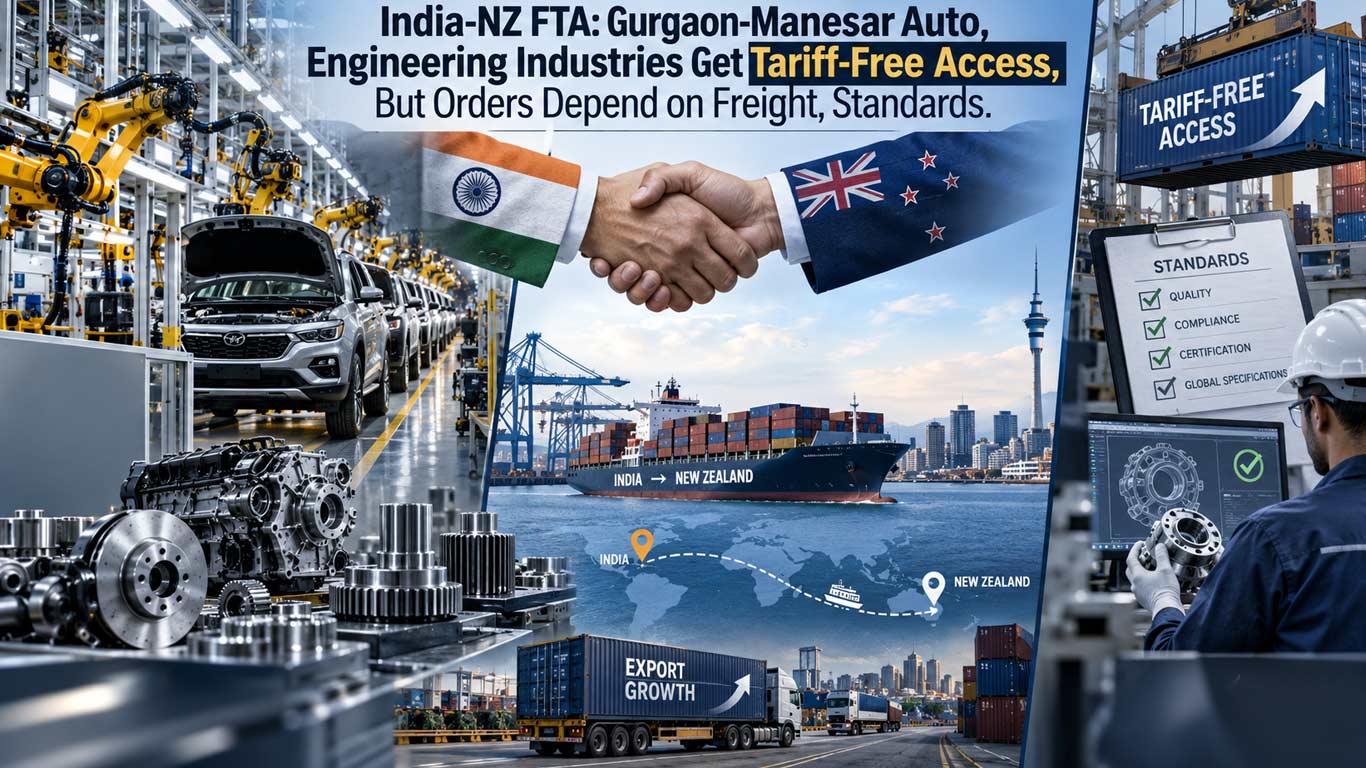
India-NZ FTA: Gurgaon-Manesar Auto, Engineering Industries Get Tariff-Free Access, But Orders Depend on Freight, Standards
Chandigarh, Sep 21 (KNN) The India-New Zealand free trade agreement (FTA) is set to give Gurgaon-Manesar’s automobile, auto components and engineering industries tariff-free access to the New Zealand market, although converting the tariff advantage into actual orders will depend on freight costs, standards and distribution networks.
New Zealand currently imposes tariffs of up to 10 per cent on around 450 tariff lines covering key Indian exports, including automobiles and auto components. Once the FTA takes effect, duties on all 8,284 tariff lines will be eliminated immediately, widening market access for the manufacturing cluster.
The FTA was signed in New Delhi on April 27. New Zealand’s Parliament passed the implementing legislation this week, with the bill completing its third reading on September 15.
The agreement will take effect after both countries complete their respective ratification procedures.
Market Access Versus Export Presence
Despite the tariff opportunity, India accounts for just 0.6 per cent of New Zealand’s USD 23.3 billion engineering imports, with Indian engineering exports at USD 136.3 million in FY25. The FTA removes a major tariff barrier, but freight costs, technical standards, rules of origin and distribution access will determine how much manufacturers benefit.
The pact covers automobiles and transport, engineering goods, electrical and mechanical machinery, textiles, footwear and other manufactured products. India’s total exports to New Zealand stood at around USD 711 million in FY25.
Haryana Has A Large Export Base
The potential export base in Haryana is substantial. NITI Aayog data shows the state exported motor-vehicle parts worth around Rs 7,155 crore, motor cars worth Rs 6,000 crore and motorcycles and cycles worth Rs 3,824 crore in FY24. Jewellery articles accounted for Rs 3,046 crore and women’s woven apparel for Rs 2,134 crore, TOI reported.
However, publicly available official data does not indicate how much of Haryana or Gurgaon’s exports are currently shipped to New Zealand.
Progressive Federation of Trade & Industry (PFT) Chairman Deepak Maini said manufacturers in Gurgaon’s automobile, auto components and engineering sectors could use the agreement to pursue new customers in New Zealand.
“But industry expectations will need to be tested against actual orders, as freight costs, technical standards, rules of origin and the ability of individual manufacturers to build distribution networks in New Zealand will determine how much of the tariff advantage is ultimately captured,” Maini added,” as quoted by TOI.
FTA Could Create New Trade Flows
If existing exports from Gurgaon to New Zealand are limited, the agreement could create new trade flows rather than simply reduce tariffs on established shipments. Companies already serving the market, meanwhile, could see a more immediate price benefit.
The pact also includes an investment component under which New Zealand has committed to promote USD 20 billion of private-sector investment in India over 15 years. This, however, does not represent a guaranteed investment inflow into Haryana or Gurgaon.
For the Gurgaon-Manesar cluster, the immediate gain is the removal of tariffs of up to 10 per cent on some key products. Its wider impact will depend on whether manufacturers can translate that access into orders, investment and new supply-chain relationships in New Zealand.
(KNN Bureau)







 Loading...