Women's Share In Tamil Nadu Electronics Manufacturing Workforce Rises To 44.4 Percent
Updated: Nov 05, 2026 04:27:58pm

Women's Share In Tamil Nadu Electronics Manufacturing Workforce Rises To 44.4 Percent
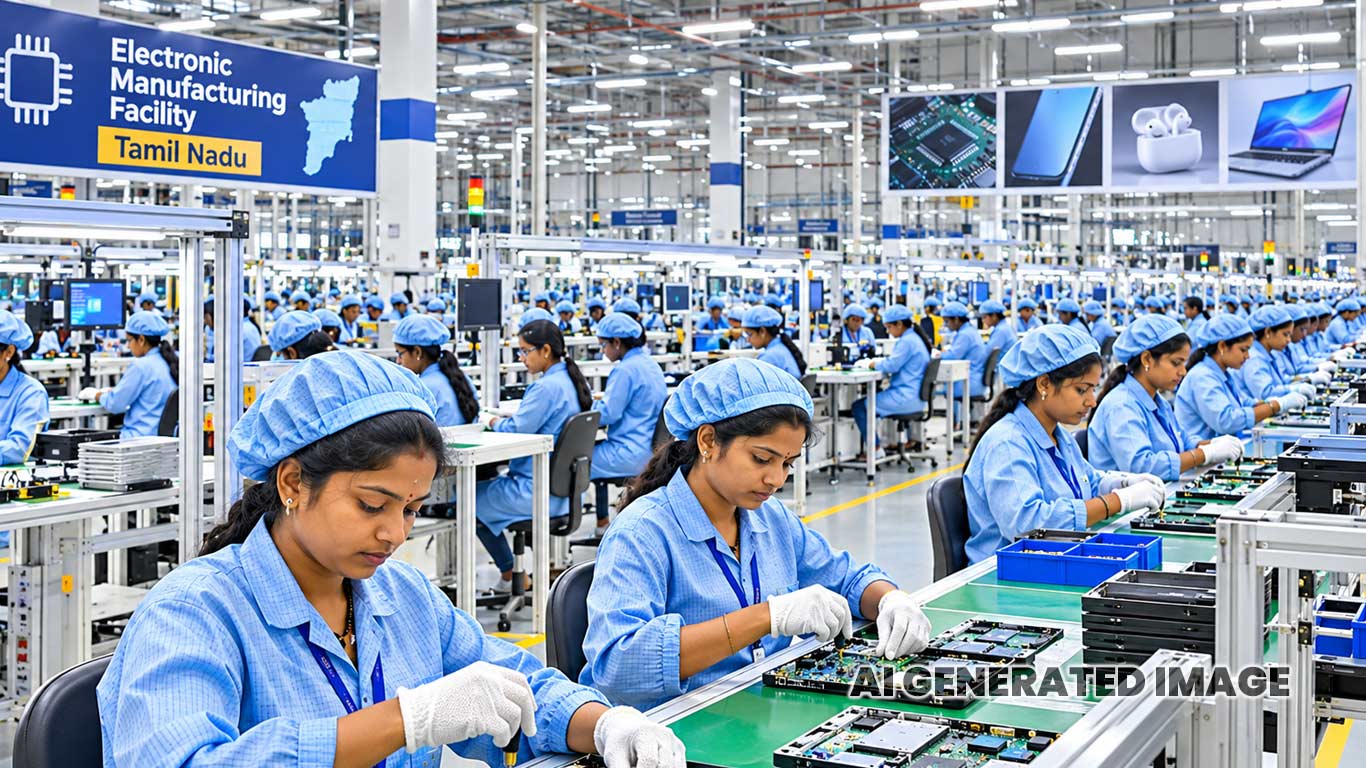
Chennai, Nov 5 (KNN) Tamil Nadu has further strengthened its position in women-led electronics manufacturing, accounting for 44.4 percent of all directly employed women in India's computer, electronic and optical products manufacturing sector in 2024-25, compared with 42.9 percent in the previous year, according to the latest Annual Survey of Industries (ASI).
The state's share of directly employed women in electrical equipment manufacturing also increased from 25.5 percent in 2023-24 to 26.2 percent in 2024-25 as stated by The Indian Express.
In contrast, Gujarat recorded a decline in its share across both segments. Its share in women employed in computer, electronic and optical products manufacturing fell from 10 percent to 7.4 percent, while the share in electrical equipment manufacturing declined from 6.5 percent to 4 percent.
The decline also reflected a reduction in the number of directly employed women in Gujarat, with 335 fewer women working in computer, electronic and optical products manufacturing and 942 fewer in electrical equipment manufacturing during 2024-25.
Contract Workers Complicate Employment Assessment
The ASI data also highlights the growing role of contract workers in manufacturing. However, the survey does not provide a gender-wise breakdown of contract employment, making it difficult to determine the actual number of women working in factories.
Across India's manufacturing sector, directly employed female factory workers increased by 96,907 to 17.38 lakh in 2024-25. Directly employed male workers rose by 4.54 lakh to 78.78 lakh. Meanwhile, the number of contract workers increased by 5.77 lakh to 70.31 lakh.
In Tamil Nadu, contract employment in computer, electronic and optical products manufacturing declined by 6,624 to 60,378. In comparison, Karnataka recorded an increase of 19,236 contract workers in the same segment.
Tamil Nadu Accounts for 40.3 percent of India's Directly Employed Female Factory Workers
Tamil Nadu continues to account for 40.3 percent of all directly employed female factory workers in India. Its manufacturing model includes providing dormitory accommodation near factories or within industrial campuses to facilitate women's participation in the workforce.
Access to workplaces and suitable living arrangements remain important factors influencing women's employment in manufacturing, particularly for migrant workers. A Tamil Nadu State Planning Commission report on migrant workers in the Chennai region, submitted in March 2025, found that 86 percent of the 811 workers surveyed came from Bihar, Odisha, Assam, Uttar Pradesh and Jharkhand. More than half of those surveyed were employed in manufacturing.
Factory Employment and Industrial Activity Expand
The latest ASI data also shows broader growth in India's formal manufacturing sector. The number of factory workers increased by 7.3 percent to 1.67 crore in 2024-25, while the number of factories rose by 2.6 percent to 2.7 lakh.
This marks the first time in more than a decade that the number of factories has increased by over 2 percent in two consecutive years. In 2023-24, factory numbers had grown by 2.7 percent.
Tamil Nadu retained its position as the state with the highest number of factories and factory workers, while Uttar Pradesh emerged as a major contributor to industrial expansion.
The survey also highlighted wage trends across states. Factory wages increased by 5.3 percent nationally to an average of Rs 2.28 lakh per worker in 2024-25. However, Jharkhand was the only state to record a decline, with average wages falling by 5.2 percent to Rs 3.04 lakh. Despite the decline, the state's average wage remained above the national level.
The Annual Survey of Industries, conducted by the Ministry of Statistics and Programme Implementation (MoSPI), covers India's formal manufacturing sector. Its findings provide insights into industrial employment, production and state-level manufacturing trends and are used in national income estimation and policymaking.
(KNN Bureau)









 Loading...