Five Indian States Outpace National Income Classification: World Bank Data
Updated: Jul 07, 2026 01:33:47pm

Five Indian States Outpace National Income Classification: World Bank Data
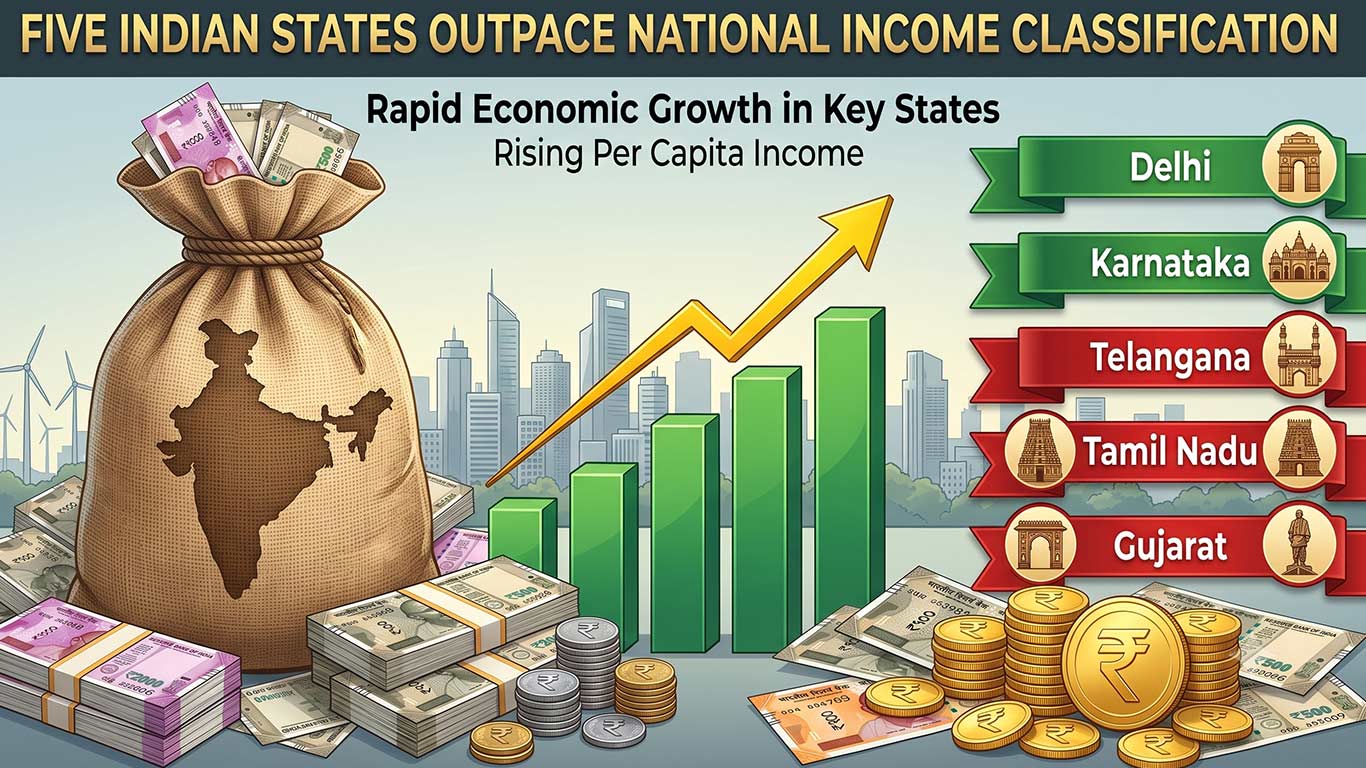
New Delhi, Jul 7 (KNN) Five Indian states have crossed the World Bank's upper-middle-income threshold based on per capita income, even though India continues to be classified as a lower-middle-income economy, according to World Bank income classifications and state-level income data.
Five States Cross Upper-Middle-Income Threshold
The World Bank classifies economies with per capita income between USD 1,175 and USD 4,635 as lower-middle income, while those above USD 4,636 fall into the upper-middle-income category.
India's per capita income currently stands at USD 2,760 under the World Bank's Atlas methodology, reported Money Control.
Among Indian states, Delhi recorded the highest per capita income at USD 6,217, followed by Karnataka (USD 5,579), Telangana (USD 5,407), Tamil Nadu (USD 5,329) and Gujarat (USD 4,734), all exceeding the World Bank's upper-middle-income threshold.
Maharashtra (USD 4,628), Haryana (USD 4,627) and Kerala (USD 4,610) narrowly missed the benchmark.
Bihar Remains Lowest-Income Major State
At the other end of the spectrum, Bihar remained the country's poorest major state with a per capita income of USD 984, followed by Uttar Pradesh (USD 1,403) and Jharkhand (USD 1,470).
The analysis noted that while no major Indian state met the current middle-income threshold in 1994-95, several states now have per capita incomes comparable to upper-middle-income economies such as South Africa, Fiji and Mongolia. Karnataka and Telangana have also surpassed countries including Indonesia and Vietnam on this measure.
Regional Income Disparities Continue to Widen
However, the report highlighted widening regional disparities. Interstate income inequality has increased over the past three decades, with the Gini coefficient across states rising from 0.230 in 1994-95 to 0.261 in 2025-26. The income gap between the richest and poorest states also widened significantly during the period.
Middle-income states recorded the fastest long-term growth, expanding their per capita incomes 36.7 times since 1994-95, compared with 28.3 times for the richest states and 26.6 times for the poorest states.
State Growth Trajectories Show Divergence
The analysis also highlighted changing state-level trajectories. Odisha, which had a per capita income similar to Uttar Pradesh three decades ago, now earns 75 percent more.
Likewise, Assam's per capita income is now 48 percent higher than Jharkhand's despite both states starting from similar income levels.
Punjab, once the highest-income large state in 1994-95, has slipped in the rankings and now reports per capita income comparable to Rajasthan, with seven states recording higher income levels.
(KNN Bureau)









 Loading...


