Manufacturing, Electricity Account For 74% Of India's Private Capex Pipeline: Report
Updated: Oct 26, 2026 01:51:51pm

Manufacturing, Electricity Account For 74% Of India's Private Capex Pipeline: Report
New Delhi, Oct 26 (KNN) India’s outstanding private capital expenditure (capex) pipeline rose 39 per cent year-on-year to Rs 99.7 lakh crore in September 2026, but increasing concentration across states and sectors, rising project sizes and potential execution delays pose risks for lenders, according to a report by Union Bank of India.
The pipeline has expanded nearly 4.1 times from its March 2014 level, with investments increasing by Rs 46.4 lakh crore over the past two years. This compares with an increase of just Rs 7 lakh crore during the eight years to March 2022.
However, the number of projects rose by only 50 per cent to 5,311 over the period, while the average project size increased 2.7 times to Rs 1,878 crore, pointing to a growing concentration of investment in larger projects.
Manufacturing And Electricity Dominate Capex Pipeline
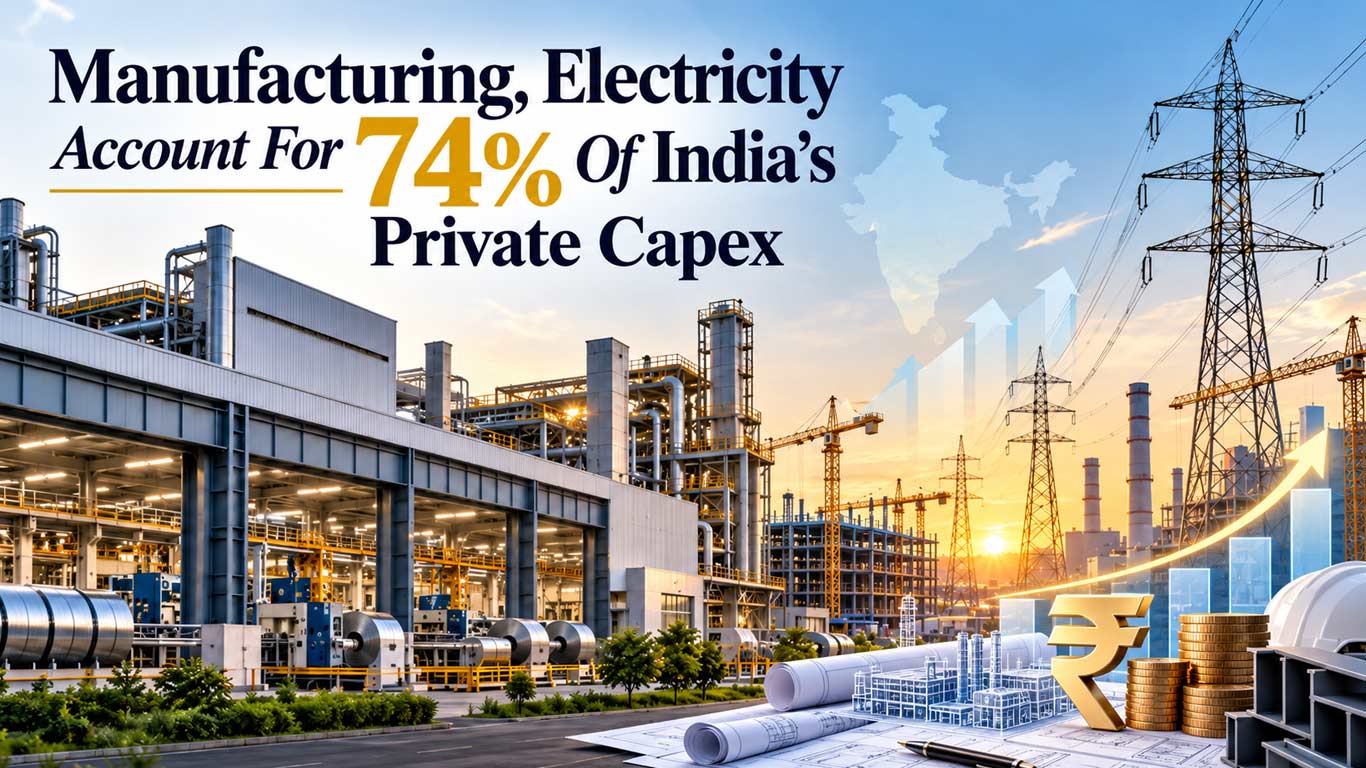
Manufacturing and electricity dominated the private capex pipeline at Rs 41.3 lakh crore and Rs 32.2 lakh crore, respectively, accounting for 74 per cent of the total. The services sector recorded the fastest growth, with its pipeline expanding 347 per cent.
Power generation, IT/ITES, metals and chemicals together accounted for 80 per cent of the pipeline, while ITES and conventional power drove 87 per cent of the annual increase, reported ANI.
Maharashtra Leads State-Wise Investment Concentration
Maharashtra’s share of India’s private capex pipeline rose to 29 per cent in September 2026 from 9 per cent in 2014, with the top five states accounting for 68 per cent of the total. Meanwhile, 21 state-industry combinations represented 59 per cent of the pipeline.
Manufacturing investments were concentrated in Maharashtra and Odisha, while electricity projects were led by Maharashtra, Andhra Pradesh and Rajasthan. Services investments were concentrated in Maharashtra, Andhra Pradesh, Telangana and Uttar Pradesh, while housing projects were largely centred in Maharashtra.
The report flagged rising geographical and sectoral concentration as a key risk, particularly as larger project sizes increase lenders’ exposure to individual investments.
Execution Delays Pose Risks For Lenders
The report warned that planned investments may not translate into actual project execution. Investment value rose 87 per cent over two years, compared with an 18 per cent increase in project numbers, reflecting a shift towards larger proposed investments.
It also flagged a gap between power generation and transmission investments, with lagging transmission infrastructure potentially delaying implementation.
“Concentration (both state wise and sector wise) and ticket size are the main risks,” the report said, highlighting the need to monitor execution and financing risks as the private investment pipeline expands.
(KNN Bureau)









 Loading...