India Links Climate Action With Development and Energy Security: Economic Survey 2025–26
Updated: Jan 29, 2026 04:22:26pm

India Links Climate Action With Development and Energy Security: Economic Survey 2025–26
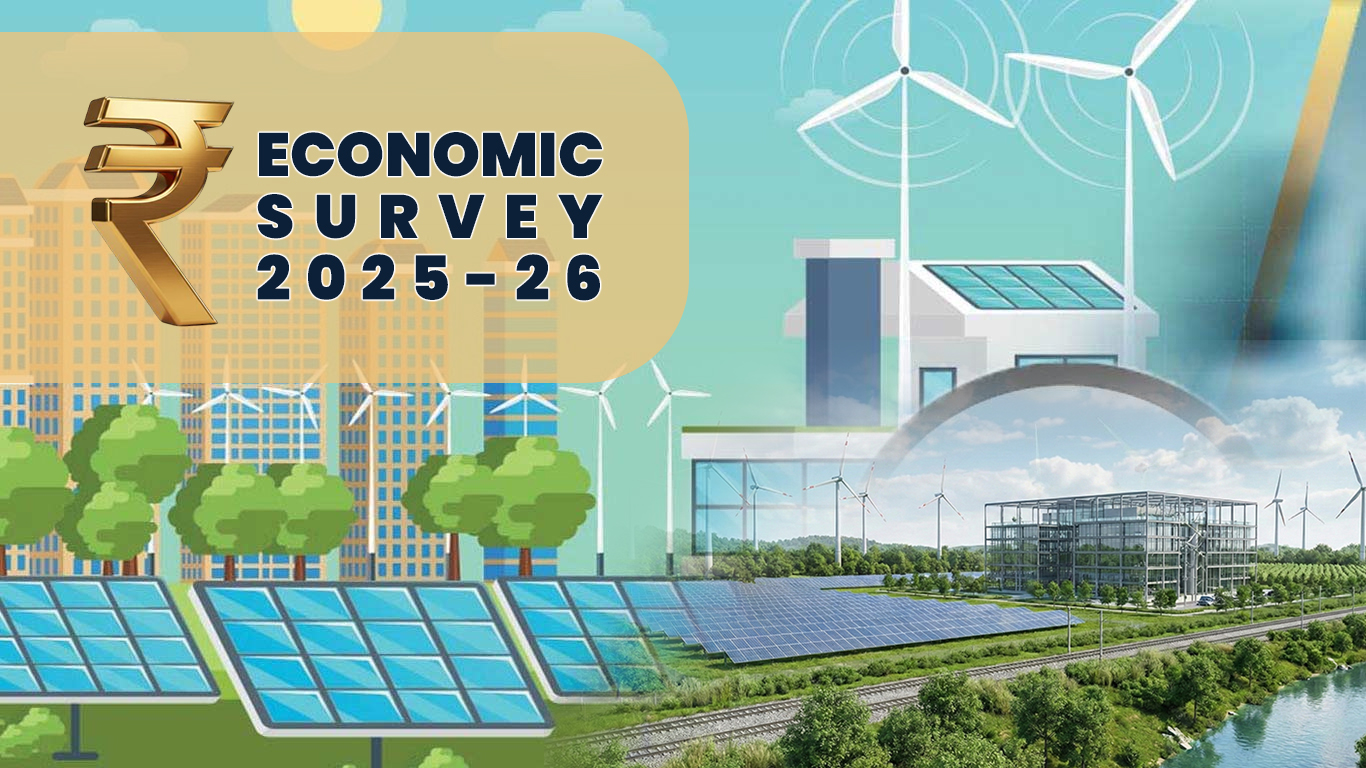
New Delhi, Jan 29 (KNN) India has adopted a development-centred, whole-of-economy climate strategy that integrates adaptation, mitigation and behavioural change within its broader growth framework, the Economic Survey 2025–26 said on Thursday, noting that development itself is a form of climate adaptation for vulnerable economies.
The Survey, tabled in Parliament by Finance Minister Nirmala Sitharaman, said the global climate agenda has reached an inflection point, marked by widening gaps between ambition and implementation amid capacity constraints and complex trade-offs.
Adaptation Central to India’s Climate Approach
Positioning adaptation at the core of its climate strategy, the Survey warned that introducing complex systems too rapidly without institutional capacity can weaken resilience.
India’s adaptation and resilience-related domestic spending rose from 3.7 percent of GDP in FY16 to 5.6 percent in FY22, driven largely by public investment in development sectors.
Climate action is anchored in the National Action Plan on Climate Change (NAPCC) and its nine missions, several of which focus on agriculture, water, ecosystems and urban resilience.
State Action Plans on Climate Change (SAPCCs) translate national priorities into local implementation, while urban planning must increasingly account for climate risks, the Survey said.
Energy Transition as a System Strategy
Sustained growth and rising living standards will require a major expansion of affordable and reliable electricity supply. While renewable energy will play a growing role, capacity additions alone do not ensure dependable power, the Survey noted, calling for a broader energy-system approach.
India has already crossed 50 percent installed power capacity from non-fossil fuel sources, reaching 51.93 percent as of end-December 2025, supported by record renewable additions. FY26 also saw faster clean-energy transitions through renewables, green hydrogen and nuclear energy.
Mitigation Through Diversification and Stability
India’s mitigation strategy combines higher non-fossil fuel share, energy efficiency gains and system stability. Citing European experiences, the Survey warned against transitions that outpace investments in baseload power, transmission and storage.
Key initiatives span solar, wind, nuclear energy, green hydrogen, bioenergy and battery storage, though material availability and storage constraints remain key challenges.
The Survey said control over critical minerals, such as lithium, cobalt, nickel, copper and rare earths, is increasingly determining the pace of the global energy transition.
India’s response combines domestic capability building under the National Critical Mineral Mission with international partnerships through platforms such as the Minerals Security Partnership and the Indo-Pacific Economic Framework. State-owned KABIL has acquired lithium mining acreage in Argentina and partnered with Australia and Chile.
India enacted the SHANTI Act in December 2025, enabling private sector participation across nuclear operations, manufacturing and research. The Carbon Credit Trading Scheme (CCTS), adopted in June 2023, is moving from framework to implementation, combining compliance and voluntary offset mechanisms.
Mission LiFE and Behavioural Change
Mission LiFE (Lifestyle for Environment), launched at COP26, is described as the behavioural foundation of India’s climate policy, aligning government interventions with lifestyle and consumption changes at household and community levels.
The Survey highlighted a global climate finance gap of USD 4 trillion, with developing countries facing acute shortfalls. About 83 percent of India’s mitigation finance and 98 percent of adaptation finance currently comes from domestic sources, with funding skewed towards mature sectors like solar and wind.
Strengthening Finance and Bond Markets
India is scaling up climate finance by strengthening institutions such as IREDA, NABARD, SIDBI, PFC and REC, alongside improved disclosures through SEBI’s sustainability frameworks.
The government issued Rs 15,000 crore in sovereign green bonds in FY26, taking cumulative issuance to Rs 72,697 crore since FY23. Municipal green bonds could mobilise USD 2.5–6.9 billion over the next decade.
The Survey called for reforms in multilateral development banks, urging a shift towards risk-sharing and private capital mobilisation through guarantees and blended finance, noting that global capital remains under-deployed in the Global South due to structural risk aversion.
(KNN Bureau)









 Loading...