Indo-Pacific Economic Framework Losing Relevance Under Trump’s Trade Approach: GTRI
Updated: May 05, 2026 05:31:16pm

Indo-Pacific Economic Framework Losing Relevance Under Trump’s Trade Approach: GTRI
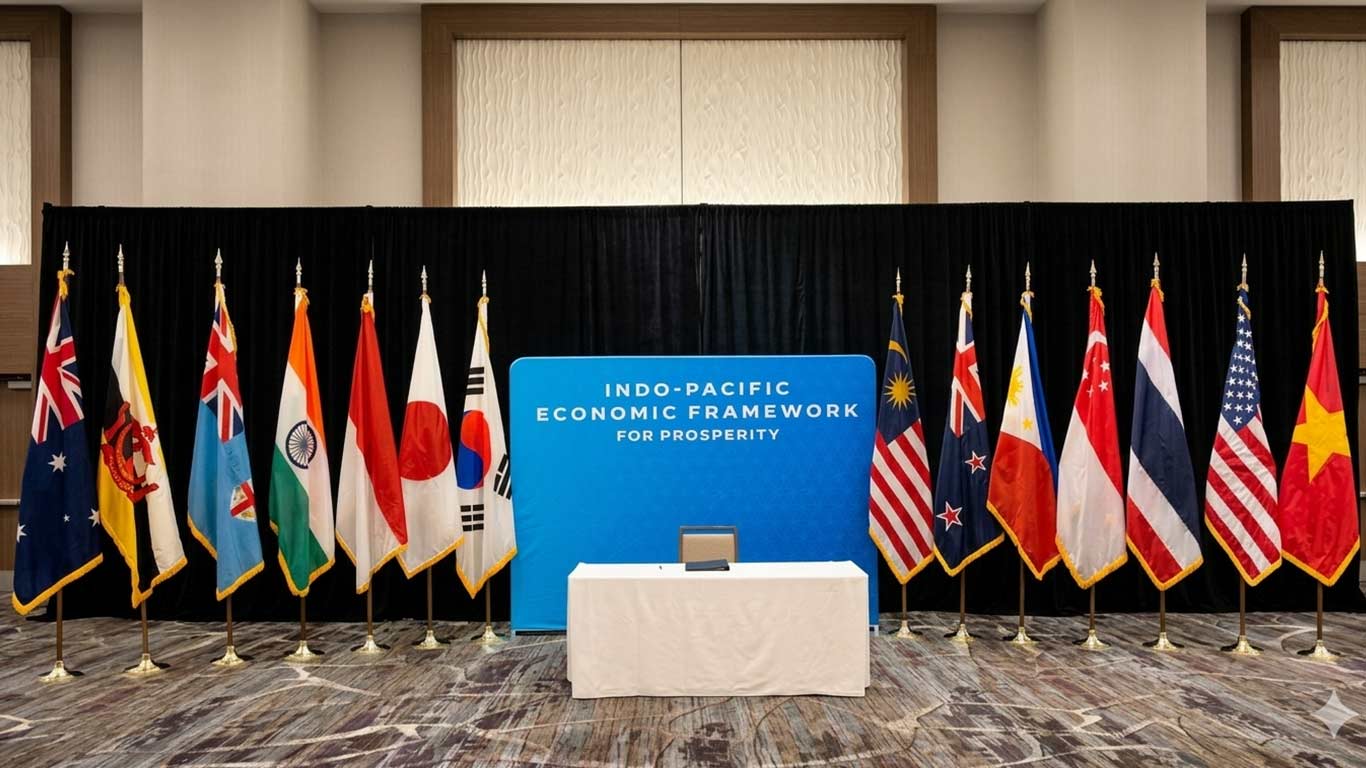
New Delhi, May 5 (KNN) The Indo-Pacific Economic Framework for Prosperity (IPEF), a 14-member grouping that includes India, the United States and Australia, is losing relevance under the aggressive trade approach of US President Donald Trump, according to think tank Global Trade Research Initiative (GTRI).
The framework, launched in May 2023 in Tokyo, represents around 40 per cent of global GDP and 28 per cent of global trade.
Limited Role in Current Trade Environment
GTRI said that in a US trade environment shaped by Donald Trump, the IPEF has “little practical role in the near term”, noting that his approach—marked by high tariffs, aggressive use of Section 301 investigations and swift bilateral deals—contrasts sharply with the bloc’s cooperative, non-binding structure, according to PTI.
Structure and Agreements
IPEF is built around four pillars—trade, supply chains, clean economy and fair economy. While the trade pillar aims to establish rules on digital trade, labour and regulatory practices, the supply chain pillar focuses on resilience and diversification.
The Supply Chain Resilience Agreement came into force in February 2024, while agreements on clean economy and fair economy became operational in October 2024.
India has joined three pillars—supply chains, clean economy and fair economy—but opted out of the trade pillar due to concerns over commitments related to digital trade and regulatory standards.
Supply Chain Diversification Faces Constraints
GTRI Founder Ajay Srivastava said the IPEF is losing relevance under Donald Trump’s aggressive trade strategy, adding that efforts to shift supply chains away from China face structural constraints.
The Supply Chain Resilience Agreement aims to reduce dependence on a few countries, including China, experts pointed to structural challenges.
It encourages member countries to diversify sourcing, identify critical sectors such as semiconductors, pharmaceuticals and critical minerals, map supply chain risks, and share real-time information on disruptions.
To support this, it has established institutional mechanisms including the Supply Chain Council, Crisis Response Network and Labour Rights Advisory Board, with India taking an active role as Vice-Chair of the SCC.
Srivastava noted that while some Tier I manufacturing, such as electronics assembly, has begun shifting to countries like India and Vietnam, deeper layers of the supply chain continue to remain heavily dependent on China.
Its dominance in Tier II components and Tier III raw materials, including critical minerals and industrial inputs, reflects decades of ecosystem development that cannot be easily replicated.
"As a result, companies are pursuing 'China 1' strategies, diversifying risk rather than exiting China altogether," he added.
Opportunities for India, With Caveats
Srivastava emphasised that while IPEF offers India an opportunity to position itself as an alternative manufacturing hub, the actual gains will depend less on the framework and more on India’s ability to undertake domestic reforms, improve infrastructure and strengthen industrial competitiveness.
(KNN Bureau)









 Loading...


