India, Netherlands Ink Multiple Agreements; Adopt Five-Year Roadmap
Updated: May 18, 2026 12:36:33pm

India, Netherlands Ink Multiple Agreements; Adopt Five-Year Roadmap
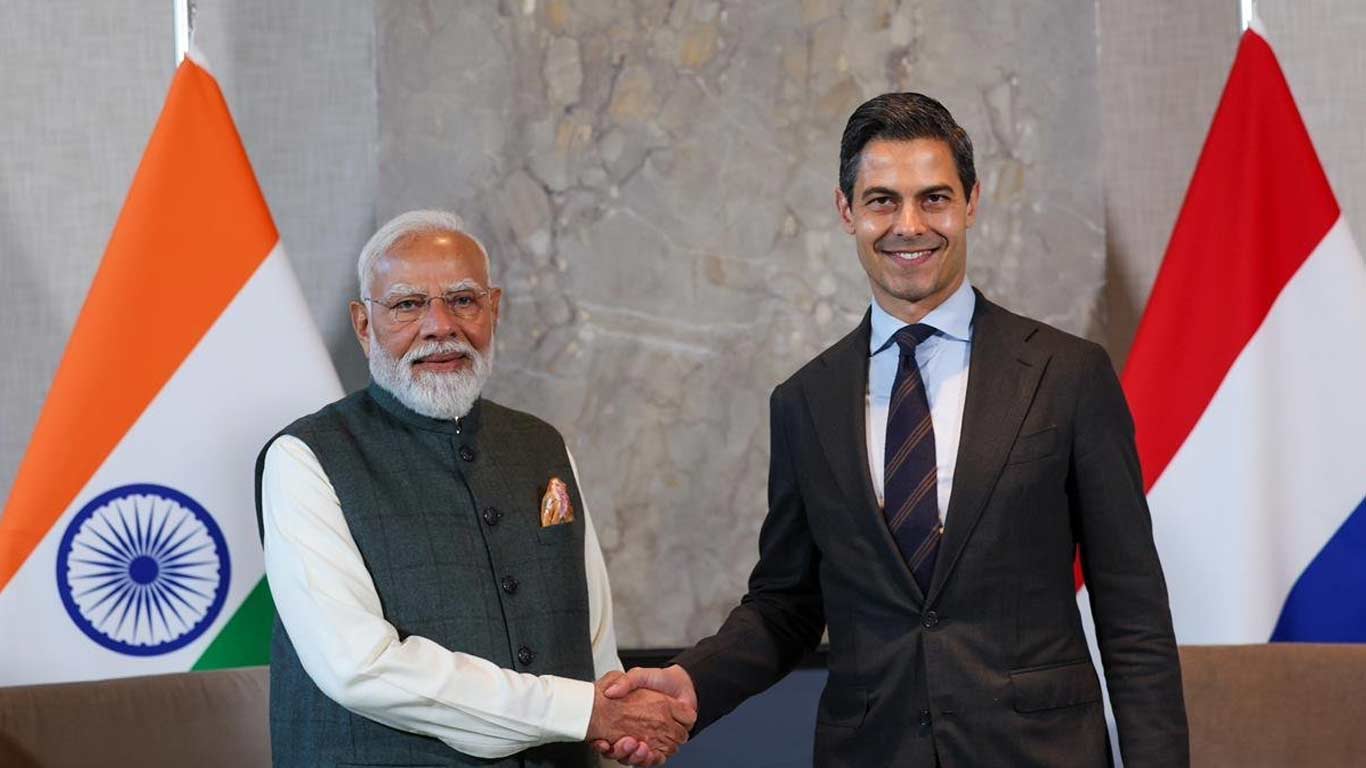
New Delhi, May 18 (KNN) Prime Minister Narendra Modi and his Dutch counterpart Rob Jetten elevated the India-Netherlands bilateral relationship to a Strategic Partnership during their meeting in The Hague on Saturday, adopting a five-year Roadmap for 2026–2030 covering trade, defence, technology, water management, energy, maritime cooperation, and education.
Trade and Investment
Both sides agreed to leverage the Joint Trade and Investment Committee (JTIC) to boost bilateral trade in sectors including semiconductors, renewable energy, pharmaceuticals, maritime, and infrastructure, with particular emphasis on small and medium enterprise (SME) participation and startup ecosystem linkages.
They also welcomed the signing of an Agreement on Mutual Administrative Assistance in Customs Matters to facilitate legitimate trade and improve customs enforcement.
Semiconductors and Emerging Technologies
A Memorandum of Understanding (MoU) on Partnership in Semiconductors and Related Emerging Technologies was signed, providing a framework for cooperation in investment, research, and talent exchange.
The Dutch Semicon Competence Centre will be connected to India's Semiconductor Mission to support startups, SMEs, and scale-ups in both countries.
A Memorandum of Cooperation was also adopted between Eindhoven University of Technology and the University of Twente and six leading Indian technical institutes — IISc Bangalore, and IITs at Bombay, Delhi, Gandhinagar, Guwahati, and Madras — for a semiconductor brain bridge, backed by industry partners NXP, ASML, Tata, and CG Semi.
A separate MoU on Critical Minerals was signed to strengthen supply chain resilience across the critical raw materials value chain.
Green Energy and Maritime
The two leaders launched an India-Netherlands Roadmap on Green Hydrogen, aimed at supporting India's production and export potential while accelerating adoption in both countries. A Joint Working Group on Renewable Energy was established, covering solar energy, green hydrogen, and battery storage.
On the maritime front, both sides agreed to develop a comprehensive Roadmap on a Green and Digital Sea Corridor — an environmentally sustainable, digitally integrated maritime corridor between the two countries — building on a Letter of Intent (LoI) signed in October 2025.
The Netherlands also joined India's Global Biofuels Alliance, launched during India's G20 Presidency, and both sides reaffirmed cooperation on circular economy, waste-to-energy, and sustainable urban mobility.
Defence and Security
A LoI on Defence Cooperation was signed, with both sides agreeing to deepen defence industrial collaboration including co-development, technology transfer, and joint ventures.
A Defence Industrial Roadmap is to be developed between the two countries' defence ministries and their respective industry bodies. Both leaders also signed a LoI on enhanced cyber cooperation, and reaffirmed their commitment to countering terrorism in all its forms.
Health and Agriculture
In the health sector, both sides renewed the MoU on Healthcare and Public Health, with focus areas including infectious diseases, antimicrobial resistance, digital health, and climate-health linkages. A LoI between the Dutch National Institute for Public Health and the Indian Council of Medical Research was also signed.
On agriculture, an Indo-Dutch Center of Excellence on Dairy Training was established in Bengaluru, and MoUs were signed between the two countries' food safety authorities — Food Safety and Standards Authority of India (FSSAI) and the Netherlands Food and Consumer Product Safety Authority (NVWA).
(KNN Bureau)



 Loading...