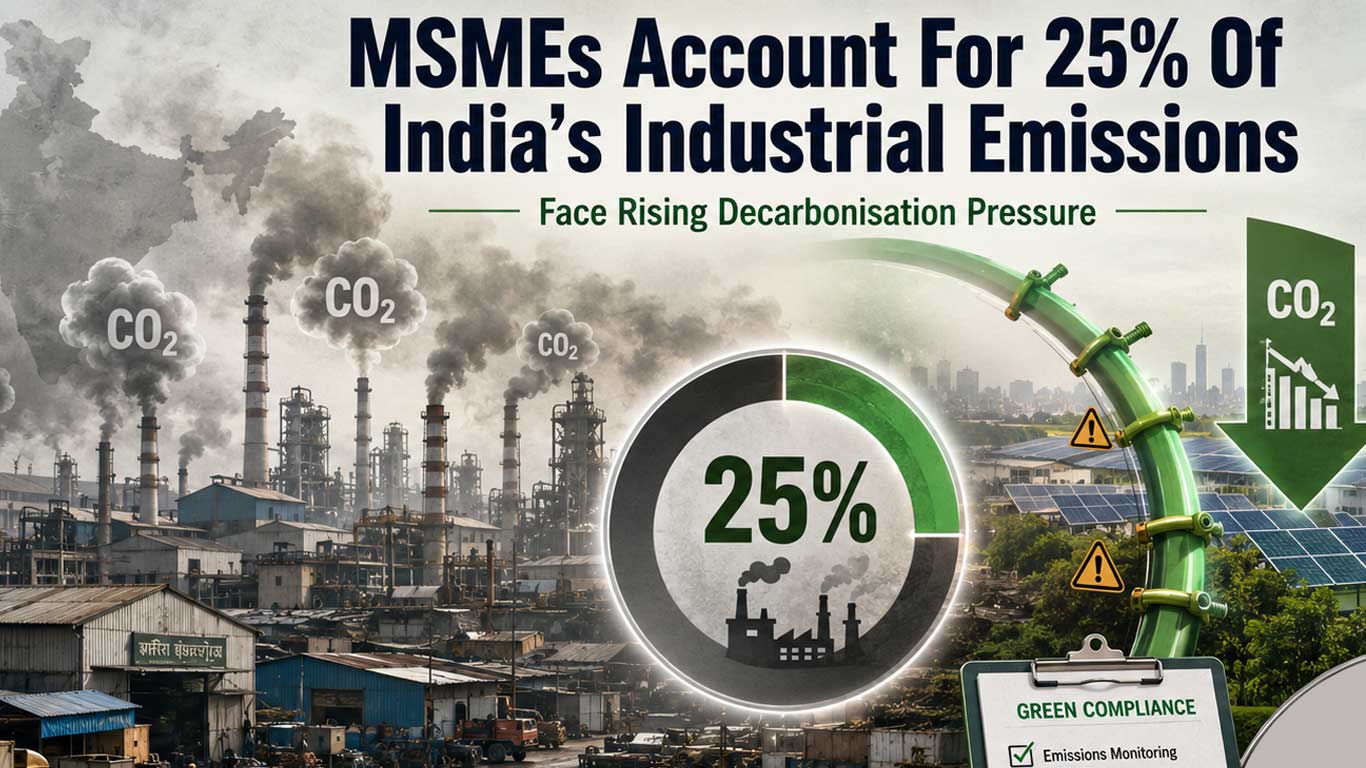
MSMEs Account For 25% Of India’s Industrial Emissions, Face Rising Decarbonisation Pressure: CSEP
Updated: Sep 01, 2026 12:45:27pm

New Delhi, Sept 1 (KNN) India’s micro, small and medium enterprises (MSMEs) account for nearly 50 percent of the country’s manufacturing exports, around 30 percent of GDP and employ more than 328 million people, according to data cited by the Centre for Social and Economic Progress (CSEP).
MSMEs Face Growing Decarbonisation Pressure
MSMEs account for an estimated 25 percent of India’s industrial emissions, making their decarbonisation crucial to the country’s 2070 net-zero goal.
However, green technology adoption remains low, with only 31 percent of MSMEs using energy-efficient products and 21 percent adopting renewable energy technologies, CSEP noted.
Global Trade Rules Raise Green Compliance Risks
The report noted that international trade regulations, including the EU’s Carbon Border Adjustment Mechanism (CBAM), supply-chain due diligence and producer-responsibility rules, are increasing decarbonisation pressures on MSMEs.
The UK, Australia and Canada are also expected to introduce carbon-related trade measures.
International Partnerships Support MSME Greening
Against this backdrop, international partnerships have supported MSME energy efficiency and green technology adoption.
CSEP mapped 18 programmes involving multilateral institutions, bilateral development agencies and climate funds, with the World Bank and UN-backed organisations among key multilateral partners and the EU, Germany, France and Japan prominent bilateral partners.
SIDBI Gains Larger Role In MSME Green Programmes
The mapping shows a shift in domestic implementation partners, with earlier programmes led largely by BEE and EESL, while initiatives since 2010 have increasingly involved SIDBI, reflecting greater focus on financial support for MSME greening.
Programmes have also evolved from energy efficiency and cost reduction to broader decarbonisation and green finance, with post-2015 initiatives increasingly incorporating climate mitigation objectives.
Green Finance Moves Beyond Grant-Based Assistance
CSEP noted that financing mechanisms are also moving from grant-based technical assistance towards larger-scale capital deployment.
The GCF-SIDBI Facility for Mitigating Emissions in MSMEs (FMAP), approved at USD 215.6 million in July 2024, and the USD 100 million AFD-SIDBI credit facility signed in February 2025 were cited as examples.
Foundry, Textile Clusters Attract Most Partnerships
The report found that foundry and metal-casting clusters have attracted the highest number of international partnerships, followed by textile clusters. Emerging interventions have also focused on dairy processing, bamboo products and clean-tech enterprises.
Green Support Remains Geographically Uneven
However, programme coverage remains uneven, with activity concentrated in clusters such as Tiruppur, Belgaum, Panipat and Kolhapur. Secondary steel and chemical industries, which could also face implications from CBAM, remain comparatively underserved.
CSEP said international partnerships have played a significant role in supporting the greening of India’s MSME sector, but noted that expanding the geographical and sectoral coverage of such programmes would be important as green compliance requirements increasingly influence global supply chains.
(KNN Bureau)






 Loading...


