Renewable Energy Could Cut Secondary Steel MSMEs’ Power Costs By 34%: Report
Updated: Aug 13, 2026 02:15:39pm

Renewable Energy Could Cut Secondary Steel MSMEs’ Power Costs By 34%: Report
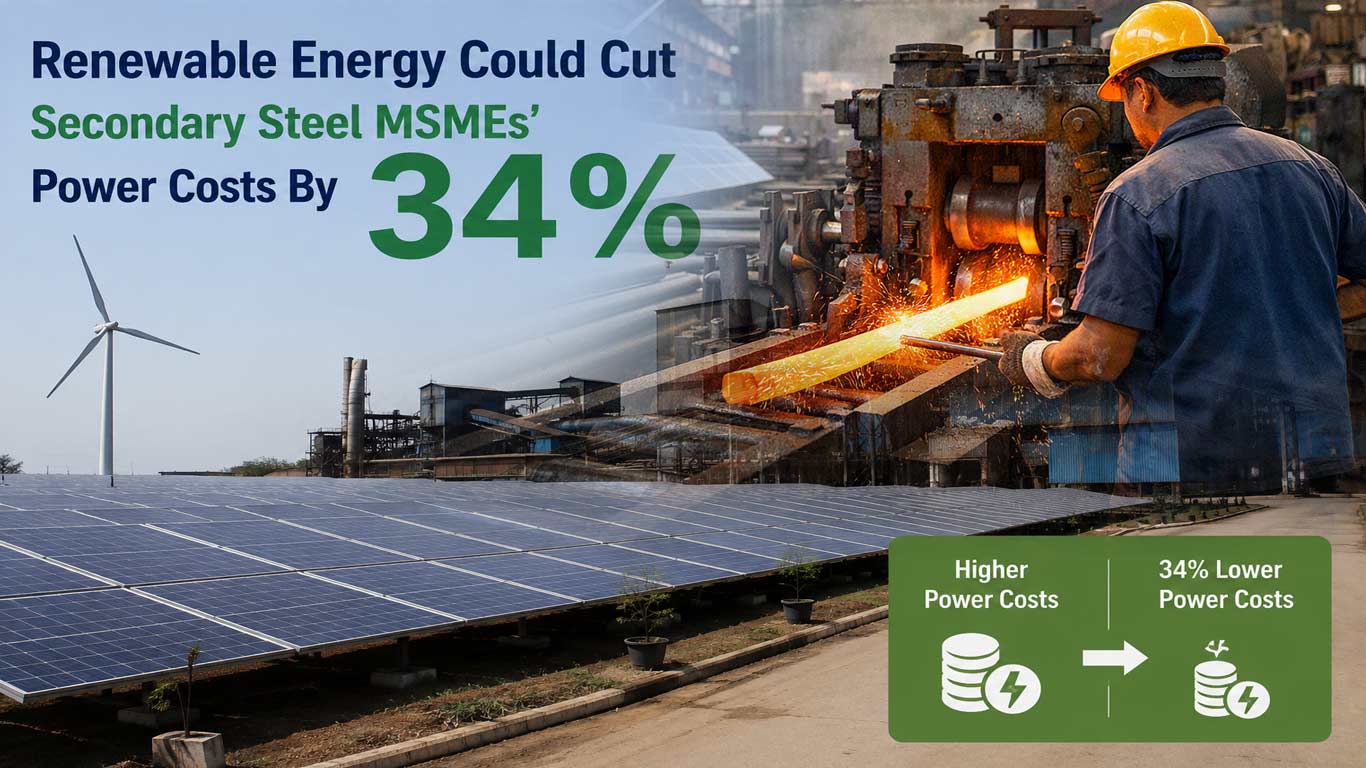
New Delhi, Aug 13 (KNN) Micro, small and medium enterprises (MSMEs) in India’s secondary steel sector could reduce their annual electricity costs by up to 34 percent and significantly lower greenhouse gas emissions by shifting to renewable energy, according to a new report.
The secondary steel sector, which is largely driven by MSMEs, accounts for around 38-40 percent of India’s total crude steel production. The sector comprises more than 1,000 fragmented units with capacities ranging from 1,000 tonnes per annum to 0.1 million tonnes per annum.
The report, titled ‘Powering India’s Secondary Steel Transition: The Business Case for Cluster-Based Renewable Electricity Procurement’, was released on Wednesday by a consortium including the Confederation of Indian Industry (CII), WWF-India, Climate Catalyst and JMK Research.
Renewable Energy Could Cut MSME Power Costs By 34 percent
Electricity accounts for up to 40 percent of operating costs for MSMEs in the secondary steel sector. Shifting to renewable energy could help individual units save around Rs 2.2 crore to Rs 2.4 crore annually, the report said.
It identified joint ownership of renewable energy plants by steel producers within industrial clusters as the most cost-effective approach. Under the model, participating units would draw electricity in proportion to their ownership stake, reported PTI.
Prabhakar Sharma, Senior Consultant, JMK Research and Analytics, said aggregating demand through industrial associations could improve project bankability, enable optimal plant sizing and distribute investment across multiple consumers, thereby reducing the risk for individual MSMEs.
Cluster-Based Procurement Can Improve Renewable Adoption
The report said a cluster-based renewable electricity procurement model could help overcome the challenges faced by fragmented secondary steel units.
By pooling electricity demand and investment, MSMEs could benefit from economies of scale while reducing the financial burden and risks associated with individual renewable energy projects.
Renewable Shift Could Cut Steel Sector Emissions
The transition could also help reduce emissions from the secondary steel sector, which is estimated to generate 50-60 million tonnes of carbon dioxide annually across more than 1,000 MSME units.
Renewable energy adoption among secondary steel MSMEs currently stands at around 11 percent, nearly half the 22 percent share of renewables in India’s overall electricity mix.
Sakshi Balani, Co-Acting CEO and Director (India), Climate Catalyst, said renewable energy integration could simultaneously reduce production costs and emissions, helping MSMEs lower their carbon footprint while improving competitiveness.
(KNN Bureau)







 Loading...


