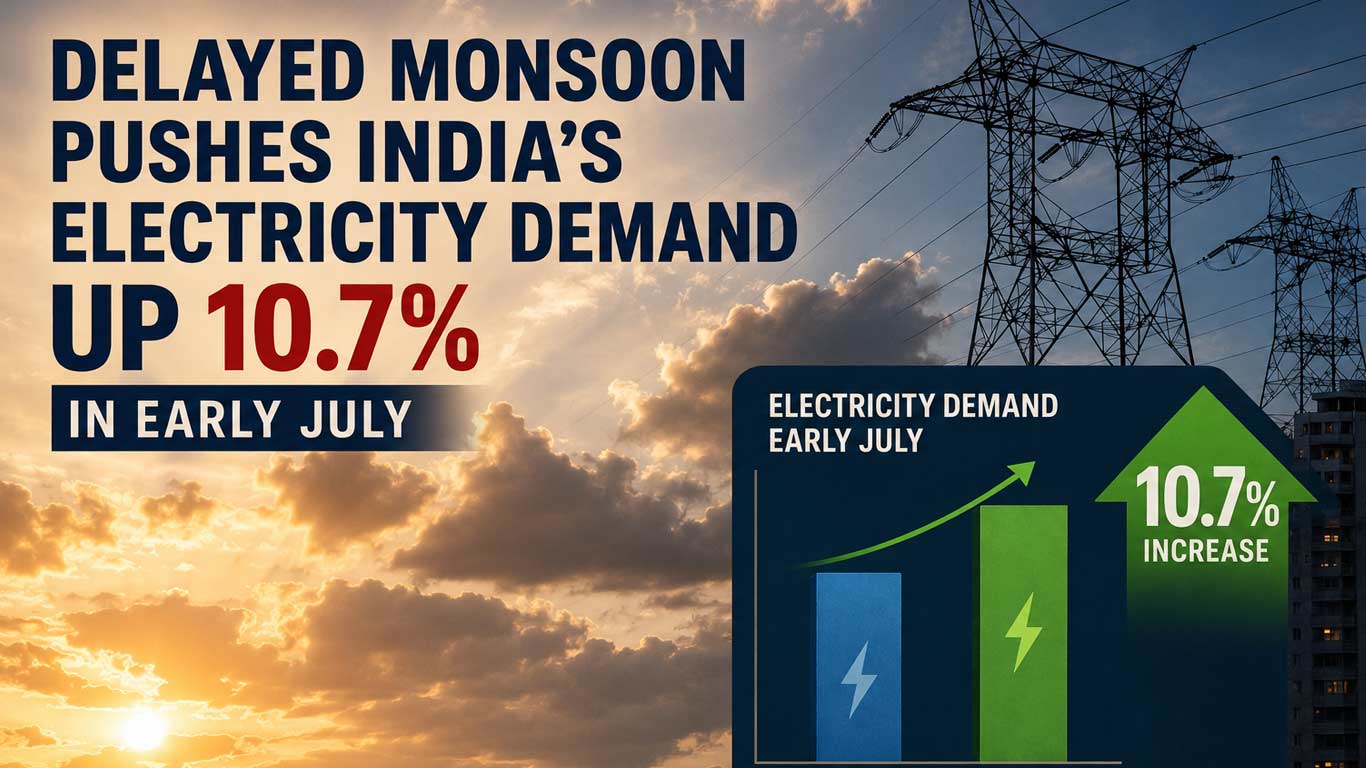
Delayed Monsoon Pushes India's Electricity Demand Up 10.7% In Early July: ICRA
Updated: Jul 25, 2026 02:10:32pm

Delayed Monsoon Pushes India's Electricity Demand Up 10.7% In Early July: ICRA
New Delhi, Jul 25 (KNN) India's electricity demand increased 10.7 percent year-on-year during July 1-16, driven by delayed monsoon rains, high temperatures and rising humidity that boosted cooling-related power consumption, according to ICRA.
Delayed Monsoon Drives Surge In Power Demand
Citing data from the Grid Controller of India Ltd. (GCIL), ICRA said the growth follows an 11.6 percent year-on-year increase in electricity demand recorded in June, reported Businessline.
The prolonged summer conditions also pushed peak power demand to record levels. India registered record peak demand met on four consecutive days from July 13 to July 16, with daytime demand ranging between 256.96 GW and 270.20 GW, while night-time demand ranged from 249.42 GW to 251.14 GW.
On July 16, the country recorded its second-highest daytime peak power demand at 270.20 GW, just below the all-time high of 270.82 GW registered on May 21, 2026.
Coal Supply Remains Adequate Despite Lower Production
ICRA Vice President and Group Head, Corporate Ratings, Ankit Jain said the delayed onset of the southwest monsoon across several regions extended periods of high temperatures, leading to higher electricity consumption for cooling.
Coal stocks at power plants stood at around 13 days as of July 18, marginally lower than 14.3 days at the end of June.
Domestic coal production declined 5.9 percent year-on-year during the first quarter of FY27, mainly due to lower output from Coal India. However, coal supply to the power sector increased 0.5 percent as thermal power plant utilisation improved during May and June.
Jain said sustained growth in coal production and supply would be important to maintain adequate buffer stocks.
Although current inventory levels remain below the normative requirement of 20 days, they are significantly higher than in previous years and are considered sufficient to meet peak demand.
Spot Power Prices Rise On Tight Supply Conditions
Meanwhile, spot electricity prices on the Indian Energy Exchange (IEX) averaged Rs 7 per unit as of July 16, compared with Rs 5.2 per unit in June and Rs 4.2 per unit in July last year.
According to ICRA, the rise in spot tariffs reflects tighter supply-demand conditions caused by delayed monsoon rains, which increased cooling demand while also limiting hydroelectric generation.
The agency expects tariffs to remain moderate during FY27, depending on the pace of capacity additions and demand growth.
(KNN Bureau)








 Loading...