Govt Launches Rs 1.27 Lakh Cr Semicon 2.0 Initiative To Boost Chip Manufacturing
Updated: Jul 16, 2026 03:48:41pm

Govt Launches Rs 1.27 Lakh Cr Semicon 2.0 Initiative To Boost Chip Manufacturing
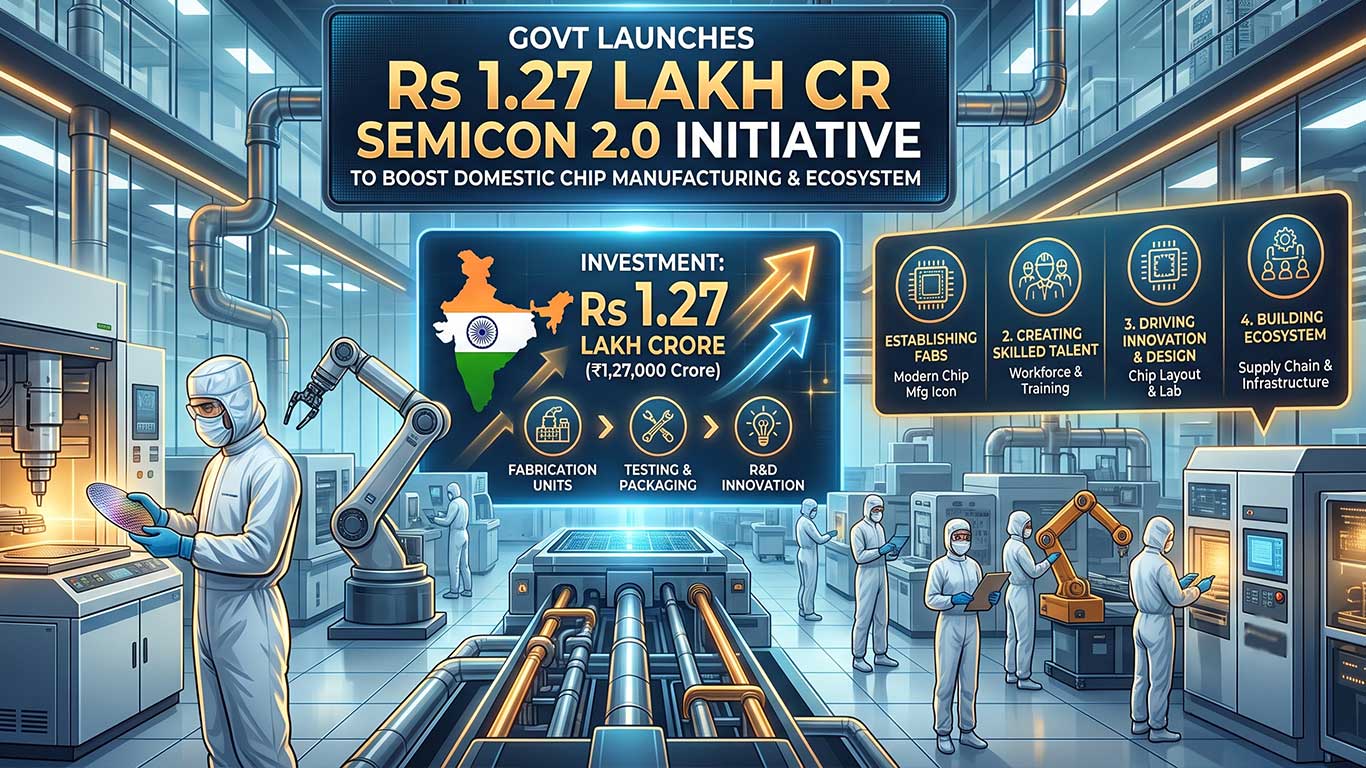
New Delhi, Jul 16 (KNN) The Union Cabinet, chaired by Prime Minister Modi, has approved the ‘Semicon 2.0’ programme with an outlay of Rs 1,27,500 crore to strengthen India’s semiconductor design and manufacturing ecosystem, building on earlier progress.
Six-Pillar Strategy for Ecosystem Development
In a release the Ministry of Electronics & IT (MeitY) said Semicon 2.0 will concentrate on six key pillars aimed at building a comprehensive semiconductor ecosystem in India.
The programme aims to strengthen chip design capabilities by building on early momentum, promoting intellectual property creation, and positioning India as a global semiconductor design hub, with over 100 startups already active in the space.
It will extend incentives to companies producing semiconductor equipment, materials, chemicals, and gases to bolster the domestic supply chain.
The government also plans to attract investments for new fabrication units, including silicon and compound semiconductor fabs, with the first facility expected by 2028.
The initiative will promote advanced packaging and testing units to enhance India’s role as an alternative global manufacturing destination.
It will further expand research and development in advanced nodes and emerging technologies through domestic and international collaborations, while scaling up talent development through university and industry training programmes, building on a base of over 68,000 trained students.
Progress Under Previous Phase
MeitY also said that 12 manufacturing projects have been approved under the earlier semiconductor initiative, with a combined investment exceeding Rs 1.64 lakh crore. These include fabrication and packaging units serving sectors such as electronics, telecom, automotive, and aerospace.
Companies including Micron Technology, Kaynes Technology, and CG Power and Industrial Solutions have commenced commercial production, while more units are expected to become operational in the coming years.
On the design front, several startups and MSMEs have been supported, many of which are developing chips for applications such as artificial intelligence, the Internet of Things, telecom, and satellite communications, the ministry noted.
(KNN Bureau)






 Loading...


