India Needs Battery Storage, Grid Investment To Meet 500 GW Clean Energy Target: Experts
Updated: Oct 26, 2026 02:56:31pm

India Needs Battery Storage, Grid Investment To Meet 500 GW Clean Energy Target: Experts
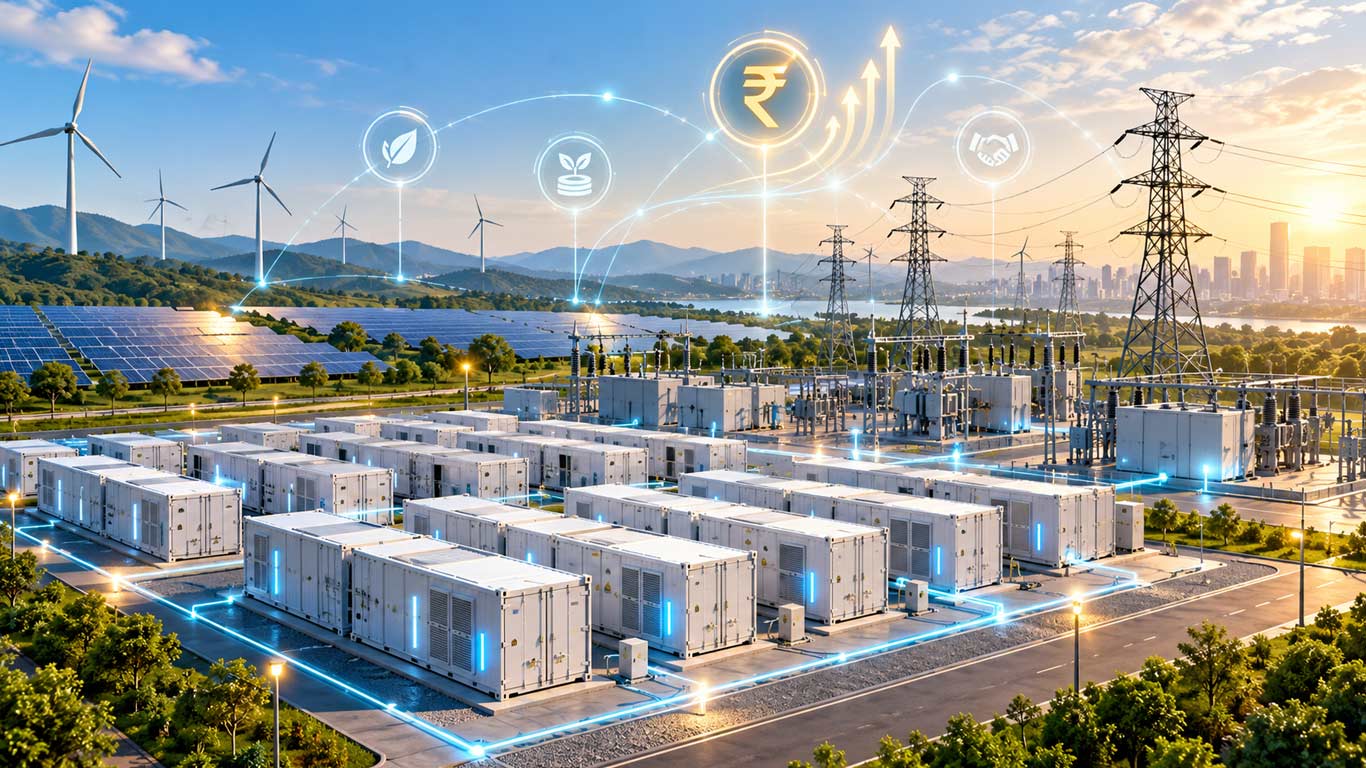
New Delhi, Oct 26 (KNN) India needs to expand battery storage and grid infrastructure alongside renewable energy capacity to ensure reliable power supply as it moves towards its target of 500 GW of non-fossil fuel capacity by 2030, experts said at an industry event.
India has crossed 300 GW of installed non-fossil fuel capacity, but integrating more renewable power into the grid will require investments in energy storage, domestic manufacturing and research, said Jai Asundi, executive director, Centre for Study of Science, Technology and Policy (CSTEP).
The discussions took place at the Renewable Energy India Expo, held alongside The Battery Show India and the Energy Storage Summit India in Greater Noida, reported The Times Of India.
Generation And Storage Must Scale Together
Yogesh Mudras, managing director, Informa Markets in India, said renewable energy generation and grid storage must expand in tandem as the country’s clean energy market grows.
“We have reached an execution phase where generation and grid storage must scale in tandem,” he said.
India’s renewable energy market is projected to reach 486 GW by 2030, while its battery storage sector is expected to exceed USD 8.5 billion by 2031, Mudras said.
The expansion of storage capacity will be critical to managing fluctuations in renewable power generation and supporting grid reliability as the share of solar and wind energy increases.
India, Germany And Australia Explore Cooperation
Anandi Iyer, director, Fraunhofer Office in India, said the world added around 800 GW of renewable energy capacity in 2025, while global battery storage deployment reached 108 GW, up 40 per cent from the previous year.
She said India and Germany could strengthen cooperation in battery research, power electronics and advanced engineering to support clean energy technology development.
Australia’s High Commissioner to India, Philip Green, highlighted opportunities for collaboration by combining Australia’s critical mineral resources and solar technology with India’s manufacturing capabilities.
Australia produces more than half of the world’s lithium, he said, adding that cooperation could help strengthen clean energy supply chains.
Scotland First Minister John Swinney said Scottish expertise and innovation could complement India’s manufacturing scale and market potential to advance the clean energy transition.
Falling Costs Improve Renewable Energy Competitiveness
Manu Srivastav, additional chief secretary in Madhya Pradesh’s power and renewable energy department, said falling technology costs and economies of scale were making renewable energy increasingly competitive with conventional power.
Experts at the event highlighted the need to complement capacity additions with investments in storage, grid infrastructure and domestic manufacturing to support the next phase of India’s energy transition.
(KNN Bureau)









 Loading...