Solar, Grid & Refining To Drive India’s Energy Investment To USD 170 Bn In 2026: IEA Report
Updated: May 30, 2026 04:48:09pm

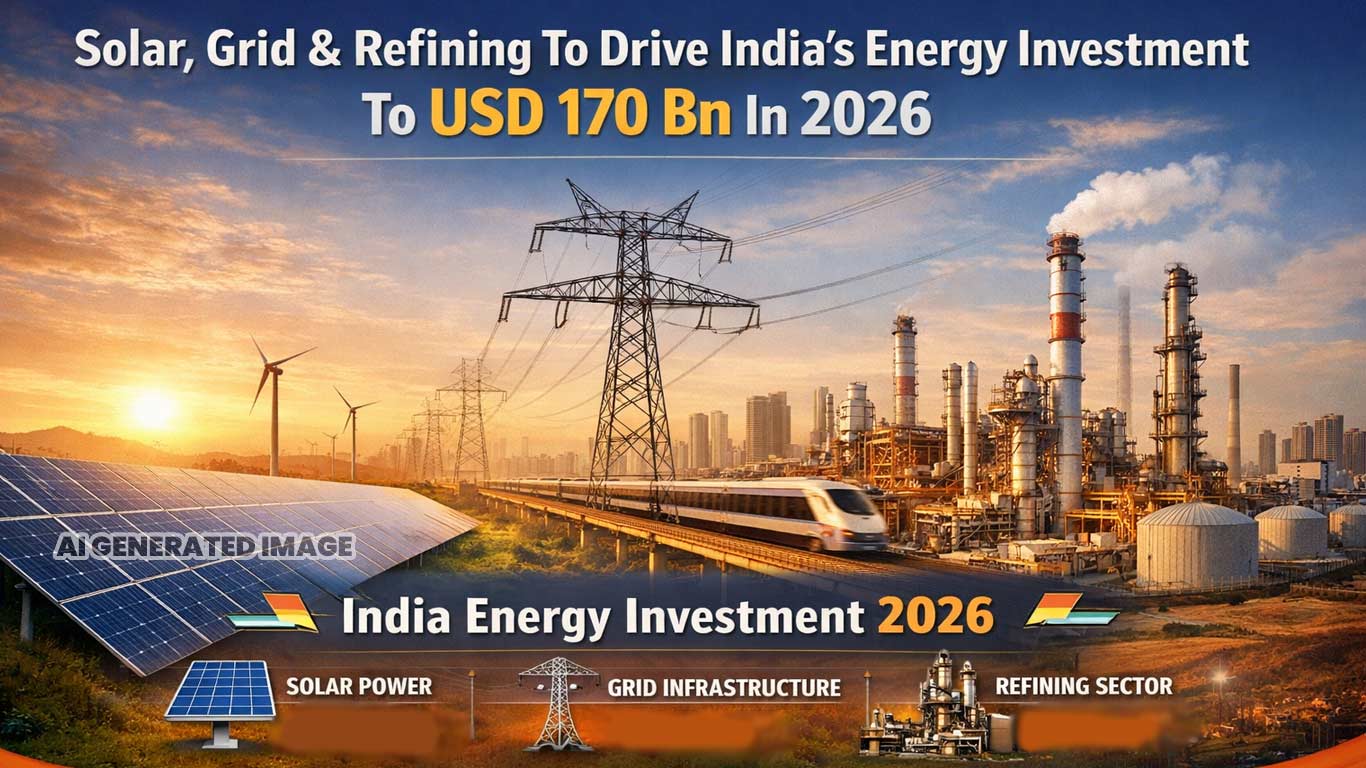
Solar, Grid & Refining To Drive India’s Energy Investment To USD 170 Bn In 2026: IEA Report
New Delhi, May 30 (KNN) India is among the world's fastest-growing energy investors, with solar power and oil refining driving a decade-high surge in spending, even as the West Asia crisis reshapes global energy priorities.
India's energy investment is on course to reach a record USD 170 billion in 2026, according to the International Energy Agency's (IEA) World Energy Investment 2026 report.
Investment has grown at an average annual rate of 11 per cent over the past five years, with solar PV rising 25 per cent annually and oil refining investment growing 23 per cent — together accounting for roughly a quarter of the overall increase in energy spending.
IEA Executive Director Fatih Birol, said, “We are in the midst of the largest energy security crisis the world has ever faced – and I believe this will reshape investment strategies globally, with parallels to the major changes the energy world witnessed after the oil shocks of the 1970s.”
Power Sector Leads; Renewables Overtake Fossil Fuels
The power sector accounts for roughly half of India's total energy investment. India now invests three dollars in renewables and nuclear for every dollar spent on fossil fuel-based generation, up from 1.5 dollars five years ago. Solar and wind together account for more than half of India's installed generation capacity, the report noted.
India achieved its Nationally Determined Contribution target of sourcing 50 per cent of installed capacity from non-fossil fuel sources in 2025 — five years ahead of schedule — supported by solar investment reaching USD 20 billion. Investment in coal-fired generation, meanwhile, has fallen to around 40 per cent of its 2010 peak.
Refining, Coal and Upstream Oil
The report emphasised that the surge in refining investment puts India on track to expand refining capacity by nearly 15 per cent by 2030. On coal, India is the world's second-largest coal supply investor, with investment expected to reach USD 13 billion in 2026 as the country targets domestic coal production of 1.5 billion tonnes by 2030, up from around 1 billion tonnes currently.
By contrast, upstream oil and gas investment has contracted by 7 per cent annually since 2020, prompting the government to introduce a new licensing regime to attract fresh exploration capital.
Nuclear, Storage and Grid Expansion
Investments in hydropower and nuclear have tripled since 2020. India is targeting 100 GW of nuclear capacity by 2047, up from 9 GW today, following 2025 reforms that allow private companies with up to 49 per cent foreign equity to build and operate reactors and small modular reactors.
Energy storage system tenders crossed 100 GWh in 2025 — more than double the prior year and ten times 2023 levels — while battery storage tariffs fell sharply from USD 14,700 per MW per month in 2023 to under USD 3,000 per MW per month in 2025.
Transmission and distribution investment is set to reach USD 26 billion in 2026, growing 15 per cent annually, supported by the Green Energy Corridor programme, which has already added over 3,000 km of new transmission lines.
Global Context: West Asia Crisis Reshapes Energy Strategy
“We are already seeing intensified efforts by both producer and consumer countries to diversify trade routes and energy sources – such as advancing new pipelines and other supply infrastructure, on the one hand, and turning more to domestically available resources, on the other,” Birol said.
Globally, energy investment is projected to reach USD 3.4 trillion in 2026, with around USD 2.2 trillion directed toward clean energy, grids, and efficiency.
Despite elevated oil prices, oil investment is expected to fall below USD 500 billion for the third consecutive year. Natural gas investment is projected to rise to a decade-high USD 330 billion, driven by new LNG projects in the US and Qatar. Coal investment is set to hit USD 180 billion — the highest since 2012 — with China accounting for nearly 70 per cent of global coal supply spending.
The report also flagged that the conflict is pushing up long-term financing costs, which could disproportionately affect capital-intensive energy projects in emerging economies.
(KNN Bureau)







 Loading...