India Adds 2.7 GW Rooftop Solar Capacity As Installations Jump 125% YoY In Q1 2026: Mercom
Updated: May 29, 2026 04:19:50pm

India Adds 2.7 GW Rooftop Solar Capacity As Installations Jump 125% YoY In Q1 2026: Mercom
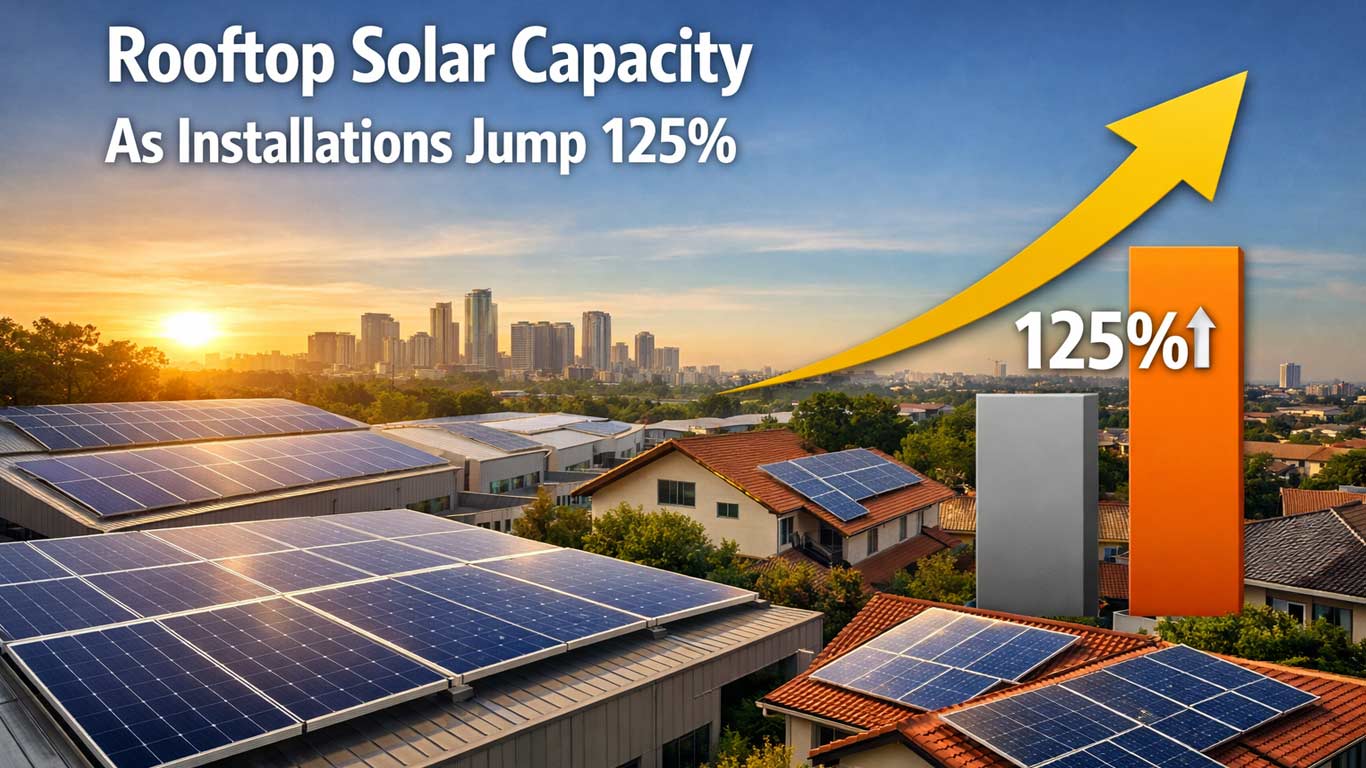
New Delhi, May 29 (KNN) India recorded its strongest quarterly rooftop solar performance in recent years, with installations surging 125 per cent year-on-year (YoY), driven largely by the government's flagship residential solar programme, according to a report released by Mercom India Research.
The ‘Q1 2026 India Rooftop Solar Market Report’ highlighted that India added 2.7 GW of rooftop solar capacity in the first quarter of 2026 — a 125.4 per cent YoY increase from 1.2 GW in Q1 2025 and a 25.4 per cent quarter-on-quarter rise from 2.2 GW in Q4 2025. Cumulative rooftop solar installations reached 23.5 GW by the end of March 2026.
PM Surya Ghar Drives Residential Surge
The growth was driven primarily by the PM Surya Ghar: Muft Bijli Yojana, supported by subsidies, simplified approvals, and expanding state-level implementation, the report noted.
Raj Prabhu, CEO, Mercom Capital Group, said, “The rooftop solar market maintained strong momentum in Q1 2026, driven primarily by robust residential demand under the PM Surya Ghar program. While consumer interest in rooftop solar remains strong, the next phase of growth will depend more on implementation and execution.”
The residential segment accounted for nearly 82 per cent of total rooftop solar additions during the quarter, with industrial, commercial, and government segments contributing approximately 11 per cent, 7 per cent, and 0.4 per cent respectively.
The capital expenditure model dominated project structures, accounting for 81 per cent of installations, while the operational expenditure or RESCO model represented the remaining 19 per cent.
State-Level Leaders
Maharashtra, Uttar Pradesh, and Gujarat led quarterly additions, contributing over 17 per cent, 16 per cent, and 15 per cent of installations respectively.
On a cumulative basis, Gujarat retains the top position with approximately 24 per cent of total installed capacity, followed by Maharashtra at 16 per cent and Uttar Pradesh at 9 per cent. The top 10 states together account for 80 per cent of cumulative rooftop solar capacity.
Among faster-growing states, Assam recorded the highest compounded quarterly growth rate at nearly 40 per cent between Q1 2025 and Q1 2026, driven by PM Surya Ghar installations and government projects, given that large-scale open-access solar is not feasible in the state, the report highlighted.
Execution the Next Frontier
Prabhu noted, “Faster approvals, access to financing, installation quality, DISCOM coordination, and grid readiness will increasingly determine how quickly the residential segment can scale. As rooftop solar penetration rises, improving on-ground execution and consumer experience will become critical to sustain long-term growth.”
ALMM Mandate May Cause Short-Term Disruption
Mercom India Managing Director Priya Sanjay emphasised that the upcoming Approved List of Models and Manufacturers (ALMM) mandate for solar cells is expected to cause some near-term disruption, particularly in the commercial and industrial rooftop segment.
“For subsidy-linked projects, domestic content requirement-compliant and ALMM-compliant modules were already mandatory. There may be an interim impact on the rooftop solar sector as the broader solar industry adjusts to the upcoming ALMM requirement for solar cells. However, consumers may still be able to use imported modules for private, non-subsidy-linked behind-the-meter projects,” Sanjay said.
Tenders and Auctions Decline
Despite strong installation numbers, rooftop solar tenders issued in Q1 2026 totalled 482 MW — a decline of over 38 per cent quarter-on-quarter, though up nearly 32 per cent YoY. Auctioned capacity fell sharply to 269 MW, a 67 per cent decline from Q4 2025, the report noted.
(KNN Bureau)











 Loading...


