Battery Storage Deployment To Decide India’s Clean Energy Goals, Says JMK–IEEFA Report
Updated: May 20, 2026 05:12:11pm

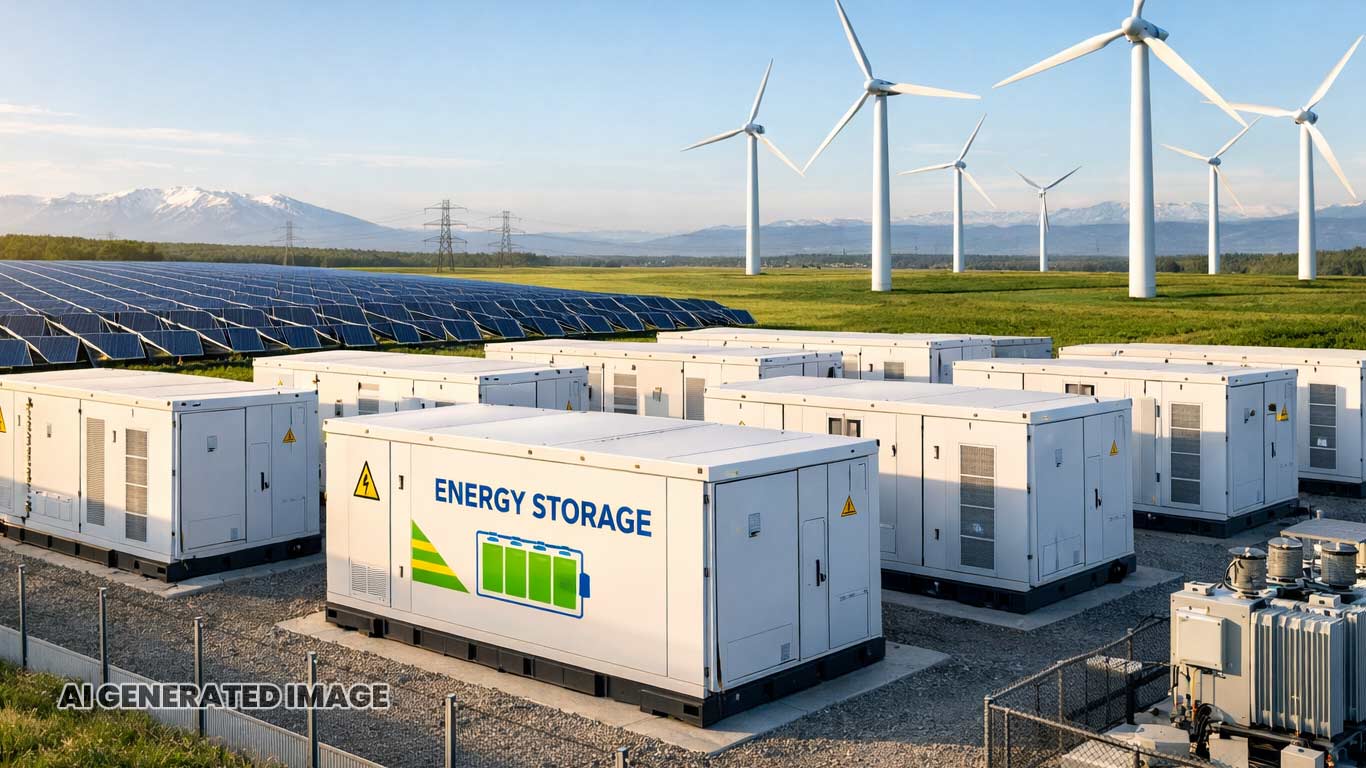
Battery Storage Deployment To Decide India’s Clean Energy Goals, Says JMK–IEEFA Report
New Delhi, May 20 (KNN) In India’s push to achieve its 500 GW renewable energy target by 2030, the pace and scale of energy storage deployment will be the decisive factor in meeting the goal, according to a joint report titled ‘Viability of standalone battery energy storage tariffs discovered in 2025’, released by JMK Research and Analytics and the Institute for Energy Economics and Financial Analysis.
India's cumulative tendered energy storage capacity has grown sharply, from 6.8 GW in 2018 to 90.7 GW in 2025.
Standalone Energy Storage Systems (ESS) — those not tied to a specific renewable generation asset — now dominate the segment, accounting for over 71 per cent of total capacity tendered in 2025. Of this, standalone Battery Energy Storage System (BESS) projects constitute 60 per cent.
Vasu Mor, Research Associate, JMK Research and Analytics, and co-author of the report, said, “The surge in standalone storage tenders has coincided with declining battery prices and supportive policy measures such as the introduction and expansion of viability gap funding for standalone BESS projects.”
Tariff Viability Remains a Concern
Despite the strong pipeline, tariff sustainability has emerged as a significant pressure point. Among the 10.4 GW of standalone BESS capacity allocated in 2025, the lowest discovered tariff fell to Rs 1.48 lakh per MW per month — well below the indicative benchmark of Rs 2.3 lakh per MW per month.
Nearly 75 per cent of allocated two-hour capacity is now considered financially risky, indicating a considerable gap between contracted tariffs and actual project costs.
Viable outcomes have largely been limited to smaller, early-stage procurements in Karnataka, Tamil Nadu, Telangana, and Gujarat.
The report recommends revisiting procurement frameworks — including the introduction of cost-reflective tariff floors, stricter eligibility criteria, and better alignment between auction design and on-ground execution realities.
Execution Delays and Supply Chain Vulnerabilities
Implementation delays of up to 18 months are anticipated due to challenges in financial closure, procurement, and commissioning. At lower tariffs, cost pressures could also compromise asset quality. The report further flags India's heavy dependence on lithium-ion technology as a structural vulnerability, exposing the sector to global supply chain disruptions.
Long-Term Outlook Remains Positive
Prabhakar Sharma, Senior Consultant, JMK Research and Analytics, and a co-author of this report, noted, “Although the near-term challenges may lead to some project cancellations or delays, the eventual growth of ESS is inevitable. This momentum is already visible, with the majority of the around 1.8 gigawatt-hour (GWh) of grid scale BESS capacity installed as of March 2026 having come online in the last six months of FY2026.”
“Meanwhile, the aggressive bidding observed in 2025 is expected to gradually normalise as market participants recalibrate to execution realities,” Sharma added.
Looking ahead, the report anticipates a diversified battery technology landscape encompassing lithium-ion, flow batteries, and sodium-ion systems, each suited to different use cases, durations, and tender configurations.
Charith Konda, Energy Specialist, India Mobility and New Energy at IEEFA – South Asia, and a contributing author, said, “Going ahead, the BESS technology landscape will be a diversified mix of storage technologies including Li-ion, flow batteries, sodium-ion etc. Their co-existence will be driven by different use cases, capacities, and tender designs, each offering distinct advantages in terms of duration, safety, lifecycle, and cost structure.”
(KNN Bureau)





 Loading...