Govt Approves 7 Projects Worth Rs 5,532 Cr To Boost Domestic Component Manufacturing
Updated: Oct 28, 2025 05:34:44pm


Govt Approves 7 Projects Worth Rs 5,532 Cr To Boost Domestic Component Manufacturing
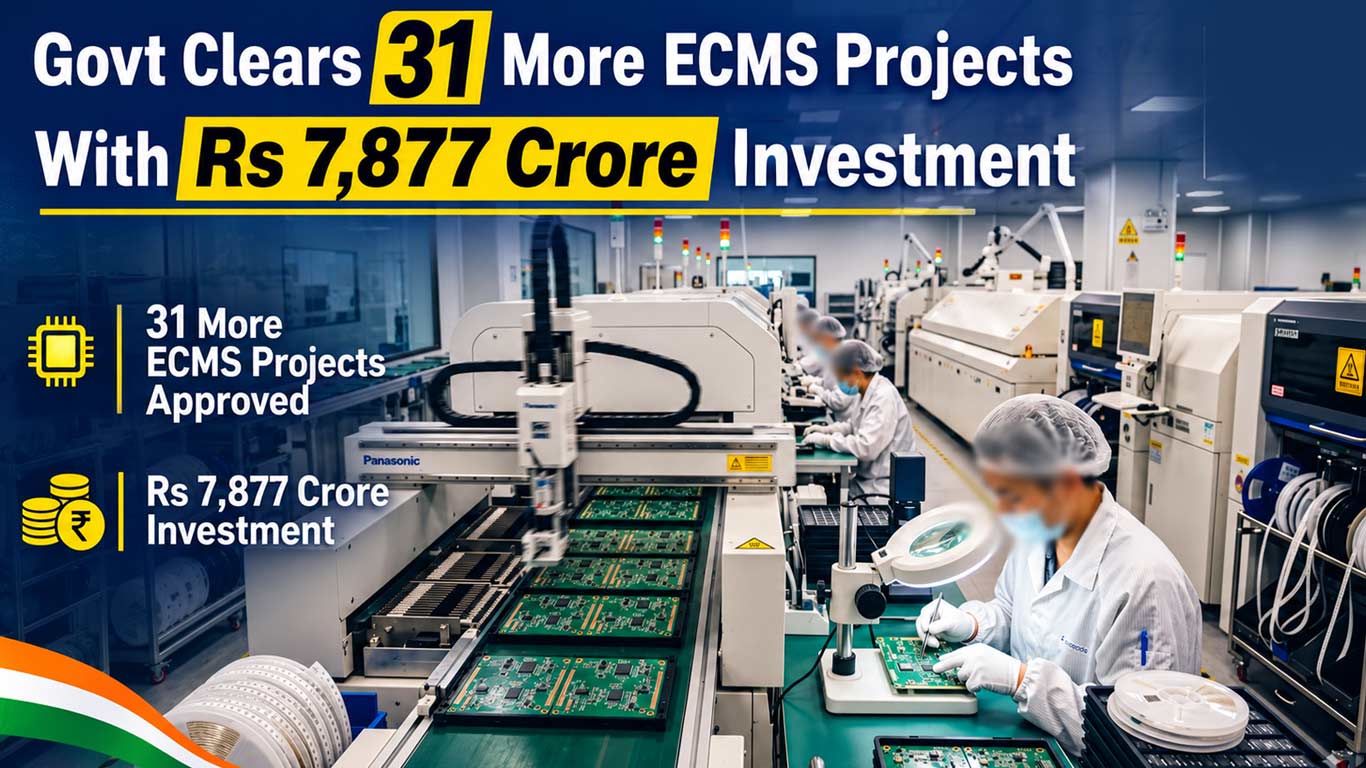
New Delhi, Oct 28 (KNN) Electronics and IT Minister Ashwini Vaishnaw on Monday announced the approval of the first tranche of 7 projects under the Electronics Components Manufacturing Scheme (ECMS).
The scheme has received an overwhelming response from both domestic and global companies, with 249 applications submitted so far.
These proposals represent a total investment of Rs 1.15 lakh crore, projected production worth Rs 10.34 lakh crore, and the creation of 1.42 lakh jobs.
The approved projects, worth Rs 5,532 crore, will facilitate the production of key components such as multi-layer and high-density interconnect (HDI) printed circuit boards (PCBs), camera modules, copper-clad laminates, and polypropylene films.
Together, they are expected to generate Rs 36,559 crore worth of components and create over 5,100 direct jobs.
The new facilities will be located across Tamil Nadu (5 units), Andhra Pradesh (1 unit), and Madhya Pradesh (1 unit).
According to the minister, the projects will help bridge the demand–supply gap for critical electronic components.
“20 per cent of our domestic demand for PCBs and 15 per cent of Camera Module sub-assembly will be met through production from these plants,” Vaishnaw said.
He added that domestic production will fully meet India’s copper-clad laminate requirement, with around 60 per cent of output from these plants earmarked for export.
The approved projects mark India’s transition from assembling finished products to manufacturing core modules, components, materials, and machinery.
Notably, India will, for the first time, establish a facility for manufacturing copper-clad laminates, a critical base material used in multilayer PCBs.
Polypropylene film production, another key material used in capacitors, will also begin domestically, serving sectors such as consumer electronics, automotive, ICT, telecommunications, and renewable energy.
The new projects are expected to reduce import dependence, strengthen supply chain resilience in strategic sectors such as defence, electric vehicles, and telecom, and generate high-skilled employment in manufacturing and R&D.
(KNN Bureau)






 Loading...