Government Proposes Mandatory Battery Storage for Larger Rooftop Solar Installations
Updated: Nov 25, 2026 04:02:55pm

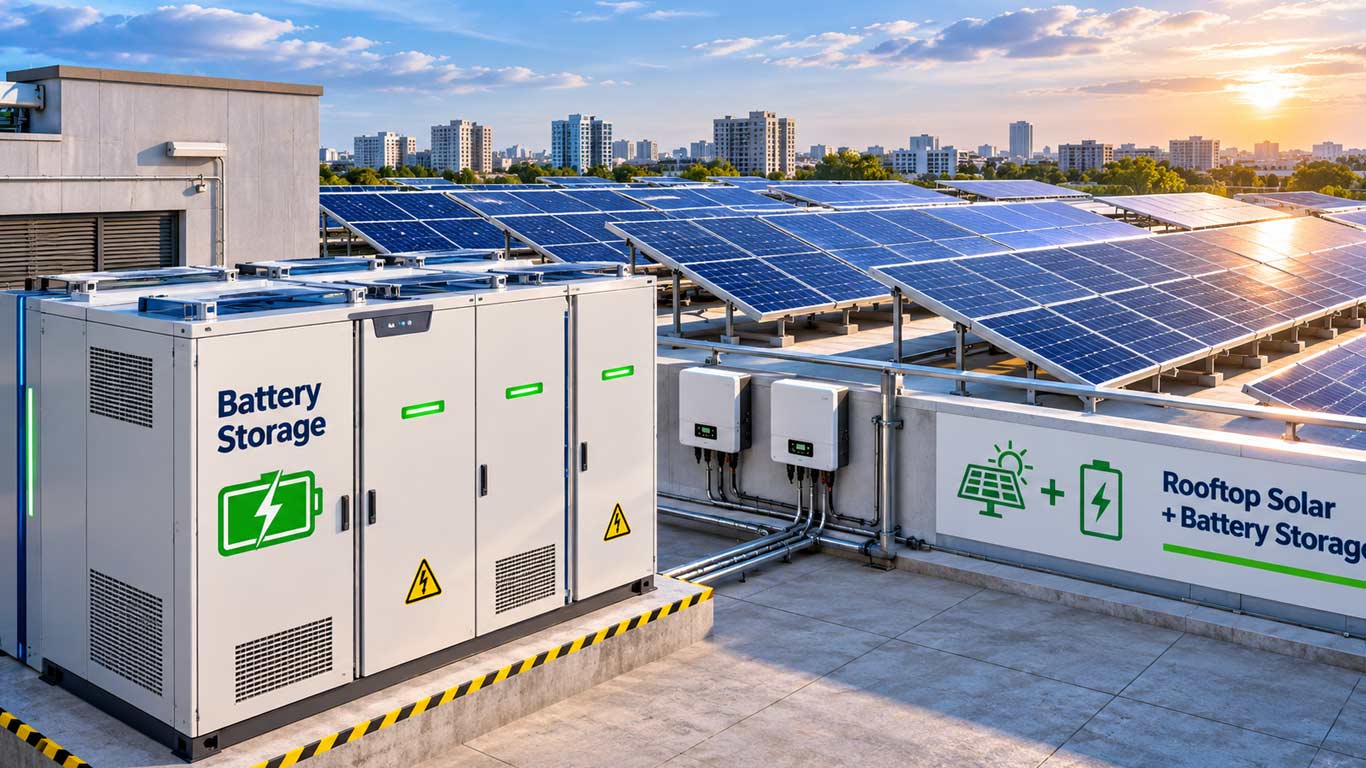
Government Proposes Mandatory Battery Storage for Larger Rooftop Solar Installations
New Delhi, Nov 25 (KNN) The government has proposed making battery storage mandatory for larger rooftop solar installations, requiring consumers to install storage capacity equivalent to at least 20 percent of their daily generation.
The move aims to address grid management challenges arising from the growing adoption of distributed renewable energy, as mentioned by The Times of India.
Under the draft Electricity (Rights of Consumers) Amendment Rules, 2026, circulated by the Ministry of Power for stakeholder comments, State Electricity Regulatory Commissions (SERCs) will determine the capacity threshold beyond which rooftop solar consumers must install energy storage systems.
If no threshold is specified, the requirement will apply to installations exceeding 10 kW.The proposed rule is scheduled to take effect from April 1, 2028.
It aims to encourage consumers to store surplus daytime solar power for use during evening peak hours, reducing pressure on distribution companies (discoms) to manage supply fluctuations and procure expensive electricity.
Changes Proposed to Net-Metering Rules
The draft also allows SERCs to levy charges on rooftop solar consumers above a specified capacity threshold, taking into account the imputed cost of energy storage and network losses. Consumers below the prescribed threshold will remain exempt.
An official said rooftop solar users inject surplus electricity into the distribution network during the day and draw power during non-solar hours without fully contributing towards fixed network costs.
“It results in increased cross-subsidisation by other retail consumers. We have tried to address this issue,” the official said.
The proposal also allows consumers to install renewable energy systems in other parts of their premises, beyond rooftops, with capacity exceeding their sanctioned electricity load, subject to limits set by SERCs.
Time-of-Day Tariffs and Consumer Protection
The government has proposed deferring the implementation of time-of-day tariffs to April 1, 2028, for consumers with maximum demand above 10 kW and April 1, 2029, for other non-agricultural consumers.
The draft also seeks to strengthen consumer protection by requiring discoms to automatically review unusually high or low electricity bills.
This will apply when consumption exceeds five times or falls below one-fifth of the average consumption recorded over the previous six billing cycles.
Consumers will not face disconnection if they continue paying based on their average consumption while the discrepancy is investigated. Discoms will be required to resolve the issue within 30 days.
(KNN Bureau)







 Loading...