India's Crude Import Bill Surges 81.5% In May Amid West Asia Crisis
Updated: Jun 20, 2026 02:40:35pm

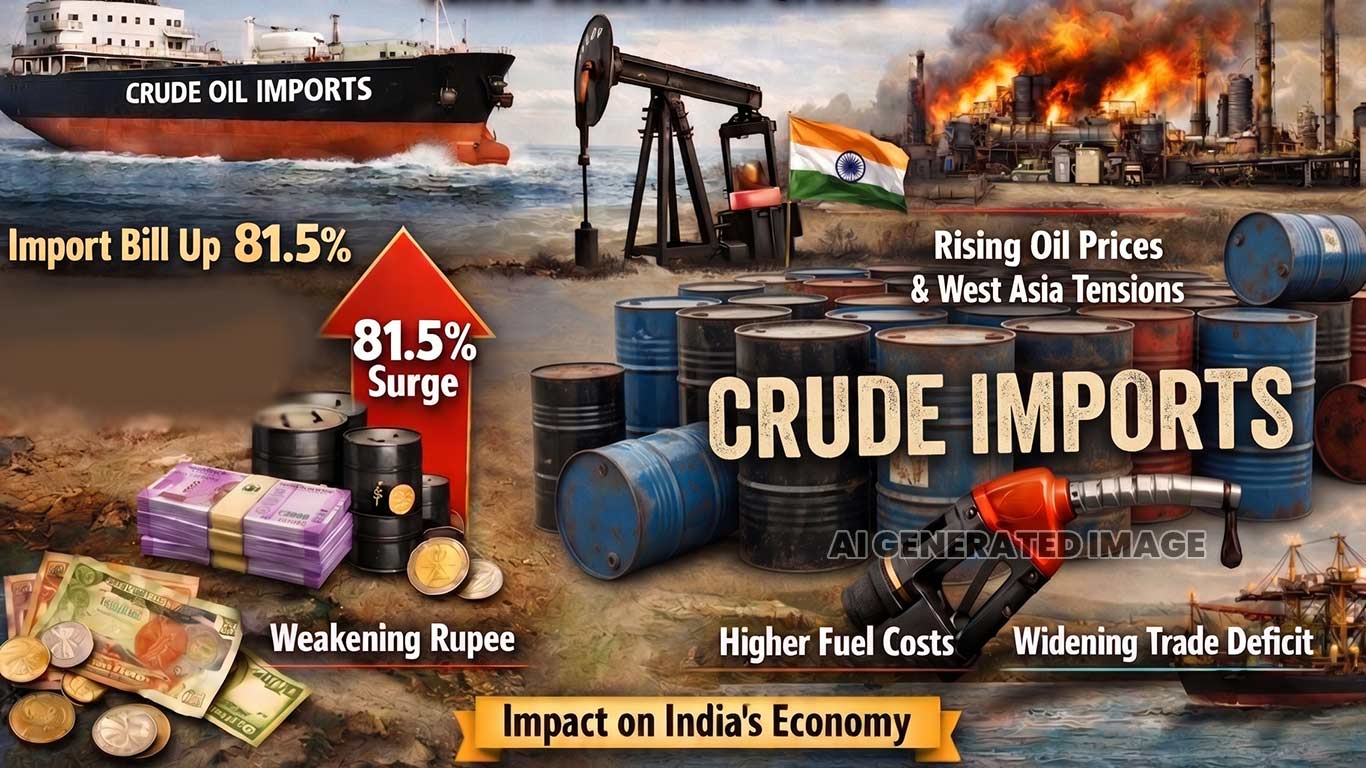
India's Crude Import Bill Surges 81.5% In May Amid West Asia Crisis
New Delhi, Jun 20 (KNN) India’s energy import bill surged sharply in May as elevated global crude prices driven by the West Asia crisis pushed up costs despite stable import volumes.
Crude Import Bill Rises Despite Stable Volumes
According to Petroleum Planning and Analysis Cell (PPAC) data, India’s crude oil import bill surged 81.5 percent year-on-year to USD 18.7 billion in May, despite import volumes remaining largely unchanged at 21.6 million tonnes, reported Business Standard.
The rise was driven by higher global prices, with the Indian basket crude averaging USD 106.23 per barrel versus USD 64.04 a year earlier.
Crude oil remains India’s largest import item, accounting for nearly 20 percent of the merchandise import bill and highlighting the economy’s exposure to global energy price swings.
Global Price Spike Driven By West Asia Tensions
The increase in import costs comes amid supply disruptions linked to West Asia tensions, including constraints in shipping through the Strait of Hormuz that have tightened global supplies and lifted prices.
India remains heavily dependent on energy imports, meeting around 90 percent of its crude oil needs, 50 percent of LNG demand and 60 percent of LPG requirements from overseas markets.
Reflecting the strain on the external account, the net oil and gas bill surged 75 percent year-on-year to USD 17.5 billion in May.
Fiscal Measures Taken To Manage Supply Pressure
Officials have responded to global volatility by imposing special additional excise duties (SAED) on petrol, diesel and ATF exports to safeguard domestic supplies.
In the latest revision on June 16, SAED was fixed at Rs 14 per litre on diesel, Rs 12.5 on ATF and Rs 1.5 on petrol. Amid weaker export incentives, petroleum product exports fell 33.9 percent year-on-year to 3.7 million tonnes in May.
During April–May, India’s crude oil import bill rose 69.9 percent to USD 35.5 billion, while the net oil and gas bill increased 51.1 percent to USD 32.2 billion, underscoring sustained pressure on the external energy balance.
(KNN Bureau)










 Loading...