India's Agri-Food Sector Must Pivot To Value Chains Model For Farmers Income Growth: ICAR DG
Updated: Aug 05, 2026 04:49:06pm

India's Agri-Food Sector Must Pivot To Value Chains Model For Farmers Income Growth: ICAR DG
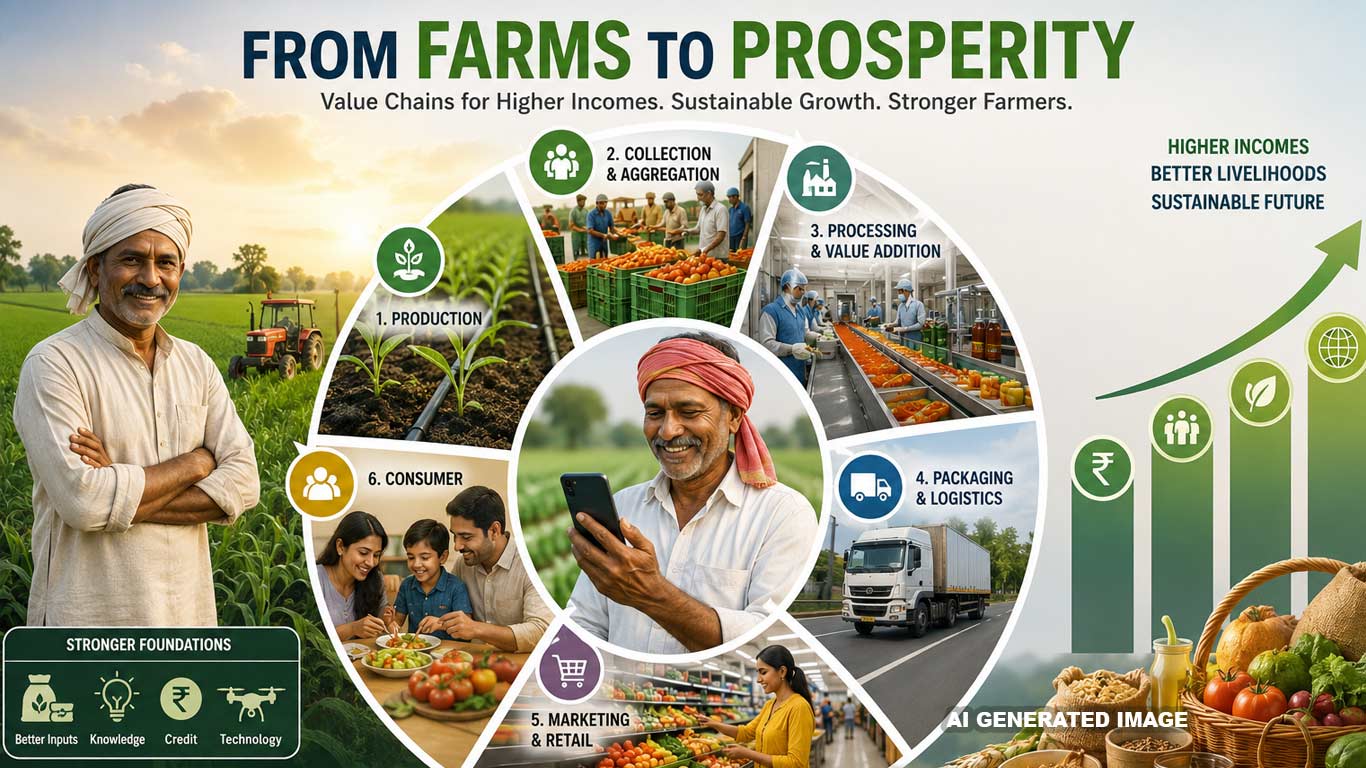
New Delhi, Aug 5 (KNN) India must shift from a production-centric agriculture model to an agri-food value chain approach to boost incomes, drive diversification, and create rural jobs, M L Jat, Secretary, Department of Agricultural Research and Education (DARE) and Director General, Indian Council of Agricultural Research (ICAR), said on Tuesday.
"We have to transition from production-centric focus to the value chain focus. That's why we say transitioning from agriculture production to the agri-food system value chain. The value chain is very, very important not only from the perspective of increasing income of the farmers but also agricultural diversification," Jat noted.
Speaking to ANI on the sidelines of the Confederation of Indian Industry (CII)-organised ‘Women in Agri & Food - Leadership Forum: Leading the Future: Driving Innovation and Strengthening Ecosystem’, he said, “Women can play a very important role in the agri-food system value chain and that will also create a lot of employment opportunities in rural India.”
Focus on Value Addition and Diversification
Jat emphasised that agriculture is evolving into a broader system built around entrepreneurship, value addition, and integrated supply chains, a shift he noted is vital for raising farm incomes, encouraging diversification, and strengthening sectoral resilience.
Women in Agri-Food Systems
The government, he said, has stepped up efforts to empower women through initiatives such as Lakhpati Didi, Drone Didi, Krishi Sakhi and Pashu Sakhi. Currently, over 100 million women are engaged through nearly 9 million Self-Help Groups (SHGs), forming one of the largest grassroots networks globally.
Jat also underlined the importance of Farmer Producer Organisations (FPOs) in strengthening the agri-food ecosystem. India has more than 10,000 FPOs, including around 1,700 led by women. However, he noted that while participation has improved, women’s representation in leadership roles remains limited and needs to expand further.
Women’s presence in agricultural education and research has increased significantly over the past decade. Jat said women now account for nearly 50 per cent of enrolment in agricultural higher education, up from less than 20 per cent a decade ago. In some institutions, their share is as high as 65–70 per cent.
Similarly, the proportion of women scientists in the Agricultural Research Service has risen from 7.9 per cent in 2006–07 to about 42 per cent currently, reflecting steady progress in gender inclusion.
Need for Sustained Policy Support
Despite these gains, Jat stressed the need for sustained and coordinated efforts to translate participation into leadership and economic empowerment. He called for a stronger institutional framework involving government, industry, research bodies and civil society to support women-led growth in agriculture.
He added that the transformation of India’s agri-food system will depend on science, innovation and inclusion, with women expected to play a key role in achieving the country’s long-term development goals.
(KNN Bureau)





 Loading...