India's Floating Solar Energy Capacity Can Go Upto 102 GWp: NISE Report
Updated: Jun 12, 2026 03:23:08pm

India's Floating Solar Energy Capacity Can Go Upto 102 GWp: NISE Report
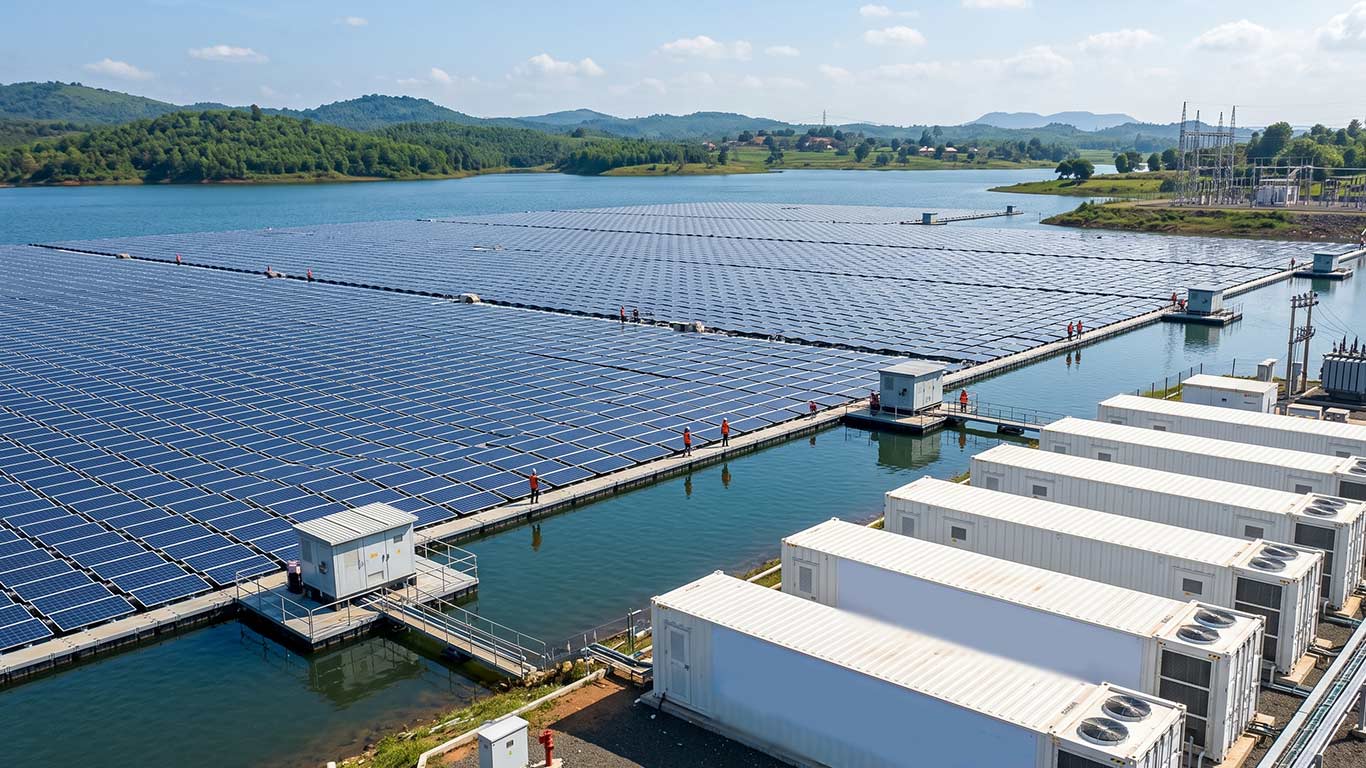
New Delhi, Jun 12 (KNN) India has the potential to develop approximately 102 gigawatt-peak (GWp) of floating solar energy by leveraging its extensive network of waterbodies, according to the first-ever national assessment released by Union Minister for New and Renewable Energy Pralhad Joshi this week.
The government will soon introduce a dedicated policy and timeline for deploying floating solar projects, the minister said.
The report, titled ‘Solar PV Potential of India: Floating Solar’, was prepared by the National Institute of Solar Energy (NISE), an autonomous body under the ministry.
Combined with the land-based solar potential of 3,343 GWp estimated by NISE last year, India's total assessed solar potential now stands at 3,445 GWp.
Where the Potential Lies
NISE mapped 11,197 waterbodies as part of the assessment and identified 682 as technically feasible for floating solar deployment, covering nearly 1,946 square kilometres of reservoir area. The assessment considered waterbodies with depths between 3 and 30 metres located within 10 kilometres of road networks and transmission substations.
Maharashtra leads the state-wise ranking with 16.3 GWp of potential, followed by Andhra Pradesh (14.9 GWp), Karnataka (13.7 GWp), Odisha (12.8 GWp), and Telangana (10.7 GWp) — all states with a large number of suitable waterbodies.
The report did not provide an estimate of the investment required to realise the full 102 GWp potential.
India's current installed solar capacity stands at nearly 158 GW, of which floating solar projects account for only 600 MW.
Policy Push and New Schemes
New and Renewable Energy Secretary Santosh Kumar Sarangi said the ministry is in discussions with the finance ministry on schemes to promote floating solar and agrivoltaics — both identified as segments with significant growth potential.
Joshi said reservoirs and waterbodies are increasingly being recognised as important assets for clean energy generation, and that the government's initiatives reflect a broader commitment to harnessing natural resources sustainably while accelerating the clean energy transition.
Small Hydro Portal and Defence Sector Collaboration
On the same occasion, Joshi launched an online portal for the Small Hydro Power Development Scheme, describing it as the first major policy intervention in the sector since 2017 and one expected to improve transparency and efficiency in implementation.
NISE and the Military Engineering Services also signed a memorandum of understanding (MoU) to expand the adoption of solar energy across defence establishments, under which NISE will provide technical support for the planning, implementation, and monitoring of renewable energy projects.
(KNN Bureau)









 Loading...