Govt Extends Excise Duty Exemption To Ethanol Blended Petrol Between 22-30%
Updated: Jun 11, 2026 01:43:18pm

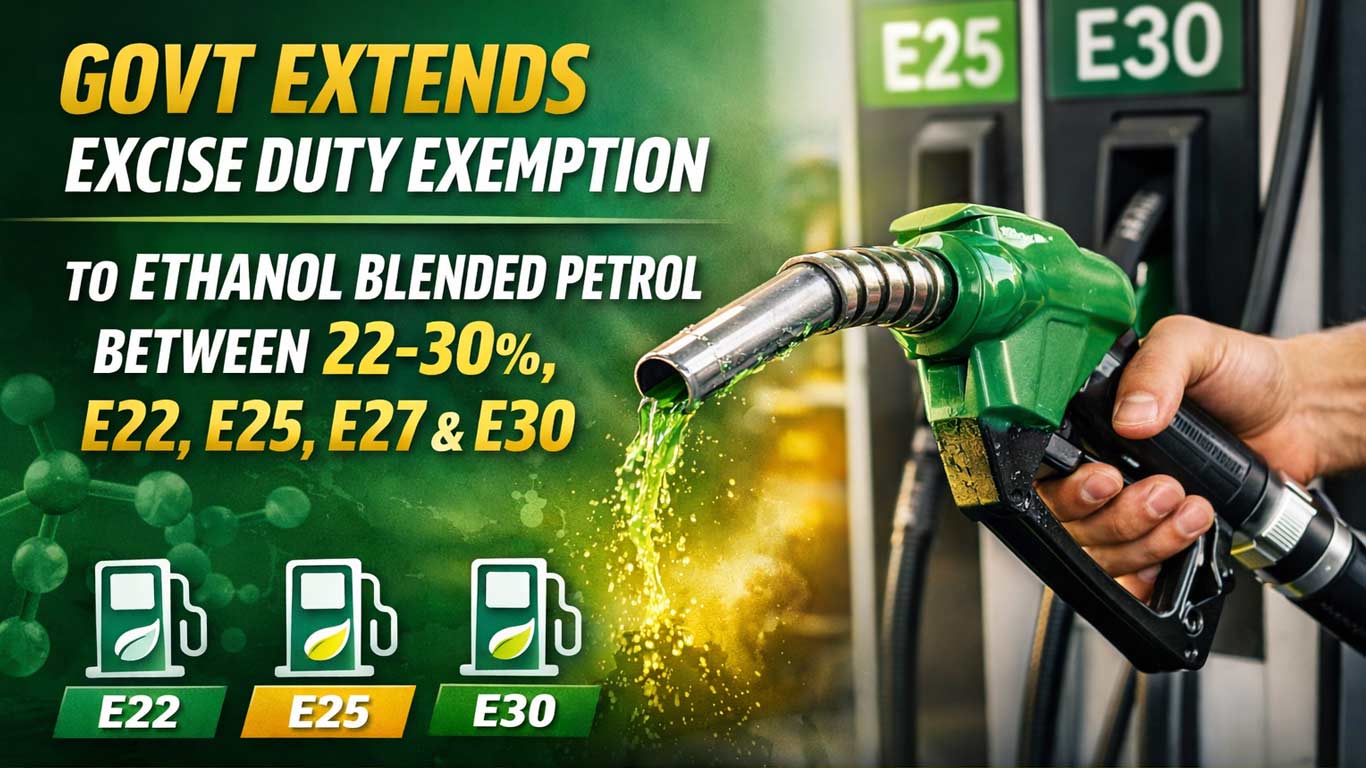
Govt Extends Excise Duty Exemption To Ethanol Blended Petrol Between 22-30%
New Delhi, Jun 11 (KNN) The government has extended central excise duty exemptions to petrol blended with higher ethanol content at 22 percent, 25 percent, 27 percent and 30 percent, marking a policy step towards expanding ethanol blending beyond the existing E20 programme.
Excise Exemptions Extended To Higher Ethanol Blends
The Department of Revenue, through a set of notifications issued recently, amended multiple excise provisions to allow nil excise duty on ethanol-blended petrol conforming to Bureau of Indian Standards (BIS) specification IS 19850.
The exemption applies to E22, E25, E27 and E30 fuel blends, provided they meet prescribed quality standards. These blends correspond to petrol mixed with 22 percent to 30 percent ethanol by volume, reported the Mint.
Policy Push Builds On E20 Milestone
The move follows the government’s approval of standards for higher ethanol-blended petrol, paving the way for commercial adoption of advanced blending levels beyond E20, which India has already achieved ahead of its target timeline.
Under the revised structure, ethanol-blended fuels will continue to attract exemptions where excise duties on motor spirit and applicable GST on ethanol inputs have been duly paid.
The amendments have been carried out through changes to existing central excise notifications and also extend exemptions from additional duties and road and infrastructure cess for the higher blends.
Ethanol Blending Programme Expands Rapidly
India’s ethanol blending programme has expanded significantly in recent years, driven by increased ethanol procurement by oil marketing companies and rising production from both sugarcane-based and grain-based distilleries.
The government has indicated its intent to move beyond E20 towards higher blending levels in the future, although a formal roadmap for E25 or E30 adoption has not yet been announced.
The Bureau of Indian Standards had earlier notified specifications for E22, E25, E27 and E30 blends in May, providing the technical framework for their potential rollout.
Industry Sees Gains In Energy Security And Utilisation
Industry stakeholders have been advocating a shift towards higher blending levels, citing surplus ethanol availability, reduced crude oil import dependence and improved energy security.
The policy push comes amid global oil market volatility and supply concerns, with India seeking to diversify fuel sources and strengthen domestic biofuel usage.
Higher blending levels are also expected to improve ethanol production capacity utilisation, which currently stands at around 50 percent.
(KNN Bureau)










 Loading...