India’s Power Capacity To Reach 874 GW By 2032: Govt
Updated: Aug 04, 2026 03:20:33pm

India’s Power Capacity To Reach 874 GW By 2032: Govt
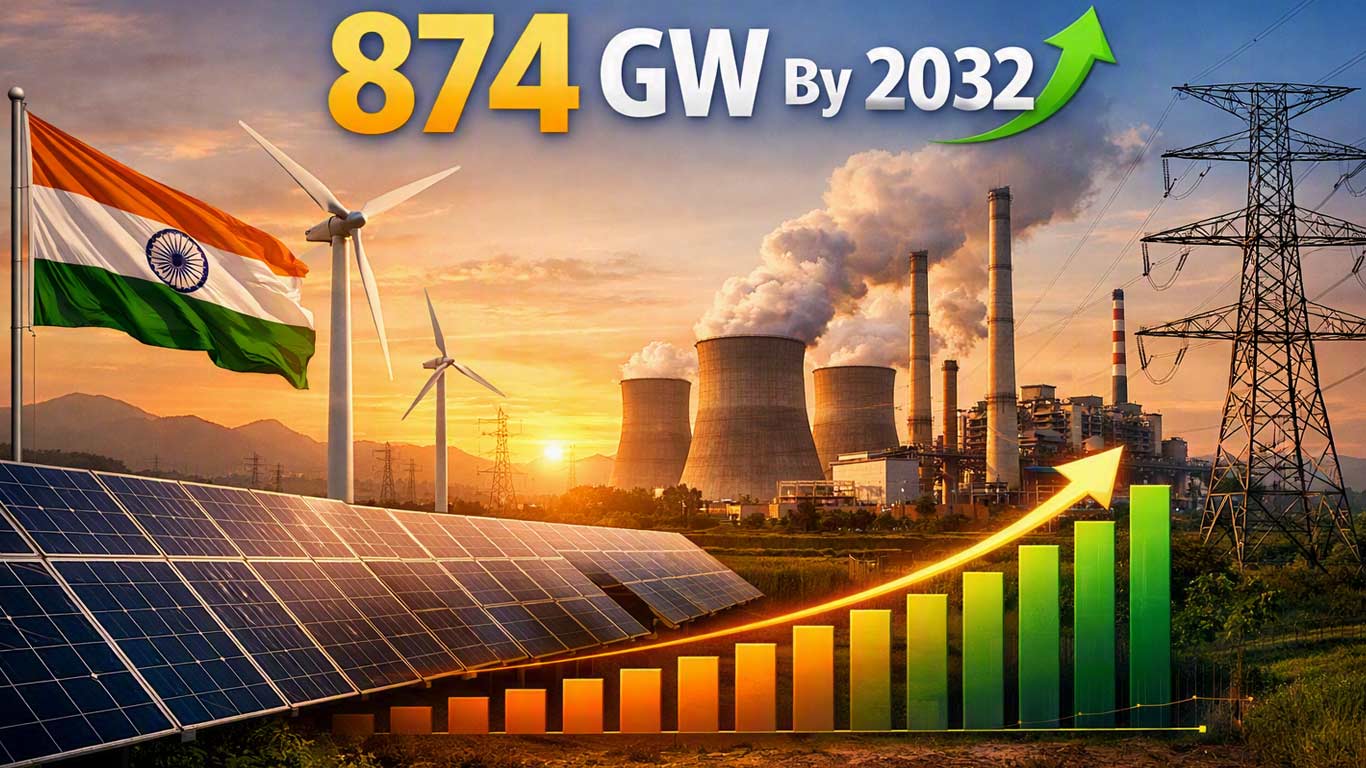
New Delhi, Aug 4 (KNN) India’s total installed power generation capacity is projected to reach 874 GW by 2031-32, as the government scales up capacity across thermal, hydro, nuclear and renewable sources, Minister of State for Power Shripad Naik informed the Rajya Sabha.
The government is also focusing on modernising the power grid and strengthening distribution networks to ensure reliable electricity supply.
Non-fossil sources cross 54 per cent of capacity
He noted that as of June 30, 2026, India’s installed power capacity stood at 5,48,858 MW. Non-fossil fuel sources accounted for 54.18 per cent of the total capacity, while renewable energy sources, including hydro, contributed 52.58 per cent, ANI reported.
Fossil fuel-based capacity made up 45.82 per cent, with coal remaining the largest individual source at 2,24,158 MW. Solar capacity reached 1,62,152 MW.
Thermal capacity expansion continues
The government said thermal power will continue to play a key role in meeting future demand. Around 21,080 MW of thermal capacity has been commissioned between April 2023 and June 2026.
An additional 47,545 MW is under construction, while contracts have been awarded for another 16,000 MW. The projected requirement for thermal capacity is estimated at around 3,15,000 MW by 2035-36.
Renewable and storage pipeline grows
India is also rapidly expanding its renewable energy and storage capacity. About 1,47,720 MW of renewable capacity is under construction, including 1,19,580 MW of solar and 27,720 MW of wind.
Energy storage is being strengthened through pumped storage projects totalling 15,870 MW/95,220 MWh and battery energy storage systems of 15,754 MW/42,530 MWh currently under development.
Transmission infrastructure push
To support rising capacity, the government plans to add 1,91,474 circuit kilometres of transmission lines and 1,274 GVA of transformation capacity between 2022-23 and 2031-32.
Advanced technologies such as STATCOMs, synchronous condensers and Flexible AC Transmission Systems (FACTS) are being deployed to improve voltage stability and facilitate renewable energy integration.
Distribution efficiency improves
The government highlighted improvements in electricity distribution performance, with aggregate technical and commercial (AT&C) losses declining from 21.91 per cent in FY21 to 15.04 per cent in FY25.
Under the Revamped Distribution Sector Scheme, Rs 1.53 lakh crore worth of loss-reduction works and Rs 1.31 lakh crore of smart metering projects have been sanctioned.
Power supply sees steady improvement
Electricity supply hours have also increased significantly. Rural areas received an average of 22.6 hours of power supply in FY26, up from 12.5 hours in FY14, while urban supply rose to 23.4 hours from 22.1 hours.
(KNN Bureau)






 Loading...


