Supreme Court Says Arbitral Tribunals Cannot Rewrite Contracts Or Grant Relief Beyond Agreed Terms
Updated: Nov 05, 2026 03:32:04pm

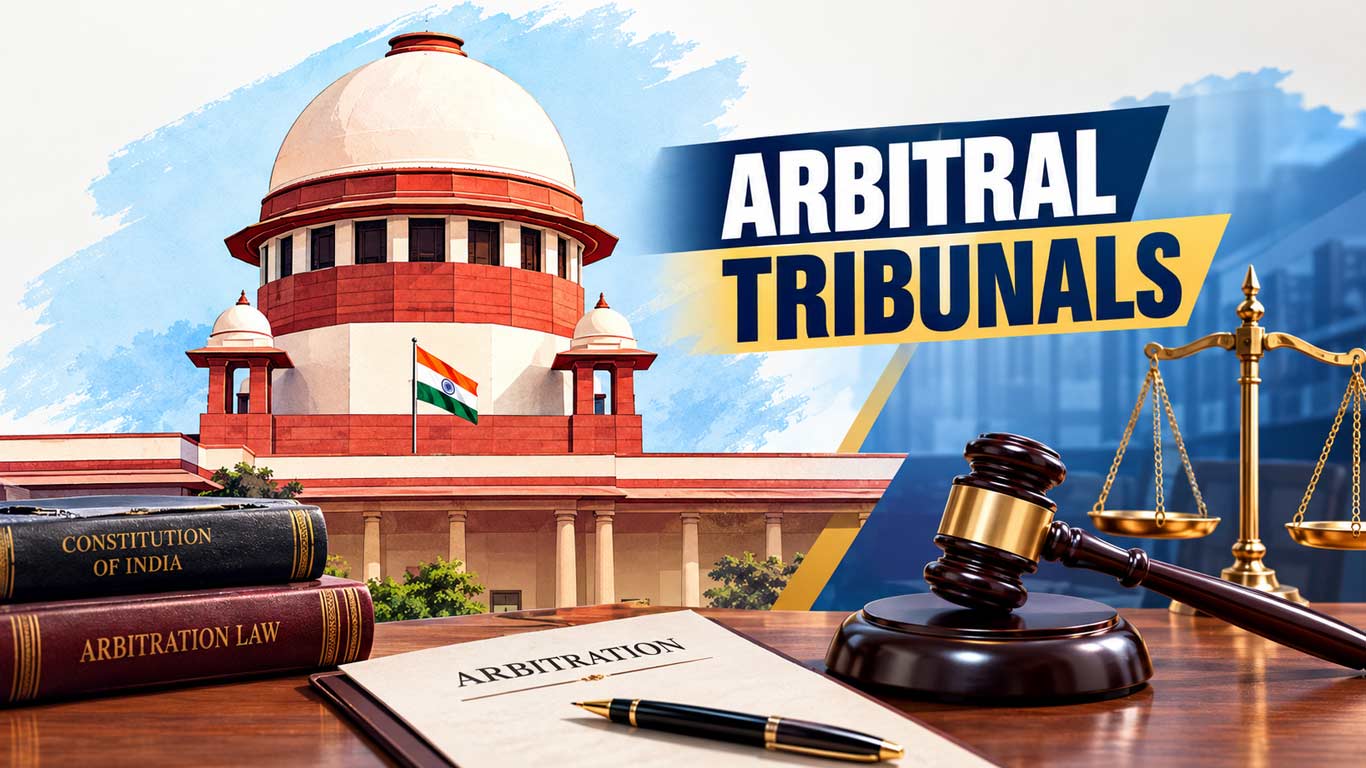
Supreme Court Says Arbitral Tribunals Cannot Rewrite Contracts Or Grant Relief Beyond Agreed Terms
New Delhi, Nov 5 (KNN) The Supreme Court has reiterated that arbitral tribunals must decide disputes in accordance with the terms of the contract and cannot rewrite agreements or grant relief contrary to the parties' contractual obligations.
The dispute arising from a property development transaction between the parties was heard by a bench of Justice Sanjay Kumar and Justice Sanjeev Sachdeva.
The matter was referred to arbitration, where the majority of the arbitral tribunal granted relief in favour of the respondents, including specific performance.
The arbitral award was challenged before the district court under Section 34 of the Arbitration and Conciliation Act, 1996.
The dispute eventually reached the Supreme Court after the High Court upheld the challenge under Section 37, examining whether the award could be sustained in view of the contractual terms and statutory limits governing arbitral decision-making.
In a judgment authored by Justice Sanjay Kumar, the Supreme Court reiterated that Section 28(3) of the Act requires an arbitral tribunal to decide disputes in accordance with the terms of the contract.
The Court observed that an arbitral tribunal derives its authority from the parties' agreement and cannot substitute its own terms for the bargain between them.
An award that disregards contractual provisions may be open to challenge under Section 34, subject to the applicable statutory grounds and standards.
Court Examines Pre-2015 Arbitration Law
Since the application to set aside the award was filed in 2012, the Court examined the matter under the unamended version of Section 34, which was in force before the 2015 amendment to the Act.
The Court noted that a mere violation of Section 28(3) would not automatically constitute a ground for setting aside an arbitral award under the unamended provision.
The 2015 amendment narrowed and clarified the public-policy ground for challenging arbitral awards and introduced Section 34(2A), which permits a domestic arbitral award to be set aside on the ground of patent illegality appearing on the face of the award, subject to statutory limitations.
In Ssangyong Engineering & Construction Co. Ltd. v. National Highways Authority of India (2019), the Supreme Court clarified that the amended provision applies to Section 34 applications filed before a court on or after the date on which the amendment came into effect.
Court Refers To Saw Pipes Judgment
In examining the applicable legal framework, the Court also referred to its decision in Oil & Natural Gas Corporation Ltd. v. Saw Pipes Ltd. (2003).
In that judgment, the Supreme Court had recognised that an arbitral award contrary to the terms of the contract could be set aside on the ground of patent illegality as part of the public-policy doctrine applicable at the time.
Applying the legal framework governing the dispute, the Supreme Court set aside the majority award granting specific performance, holding that the relief amounted to rewriting the contract.
Impact on MSMEs
The ruling reinforces contractual certainty in commercial disputes, helping MSMEs safeguard their contractual rights and assess legal remedies while reducing the risk of arbitral awards exceeding agreed obligations.
(KNN Bureau)






 Loading...