CAG Flags 1,334 GST Non-Compliance Cases Involving Rs 401 Crore In Works Contracts And Construction Sector
Updated: Aug 14, 2026 04:34:10pm

CAG Flags 1,334 GST Non-Compliance Cases Involving Rs 401 Crore In Works Contracts And Construction Sector
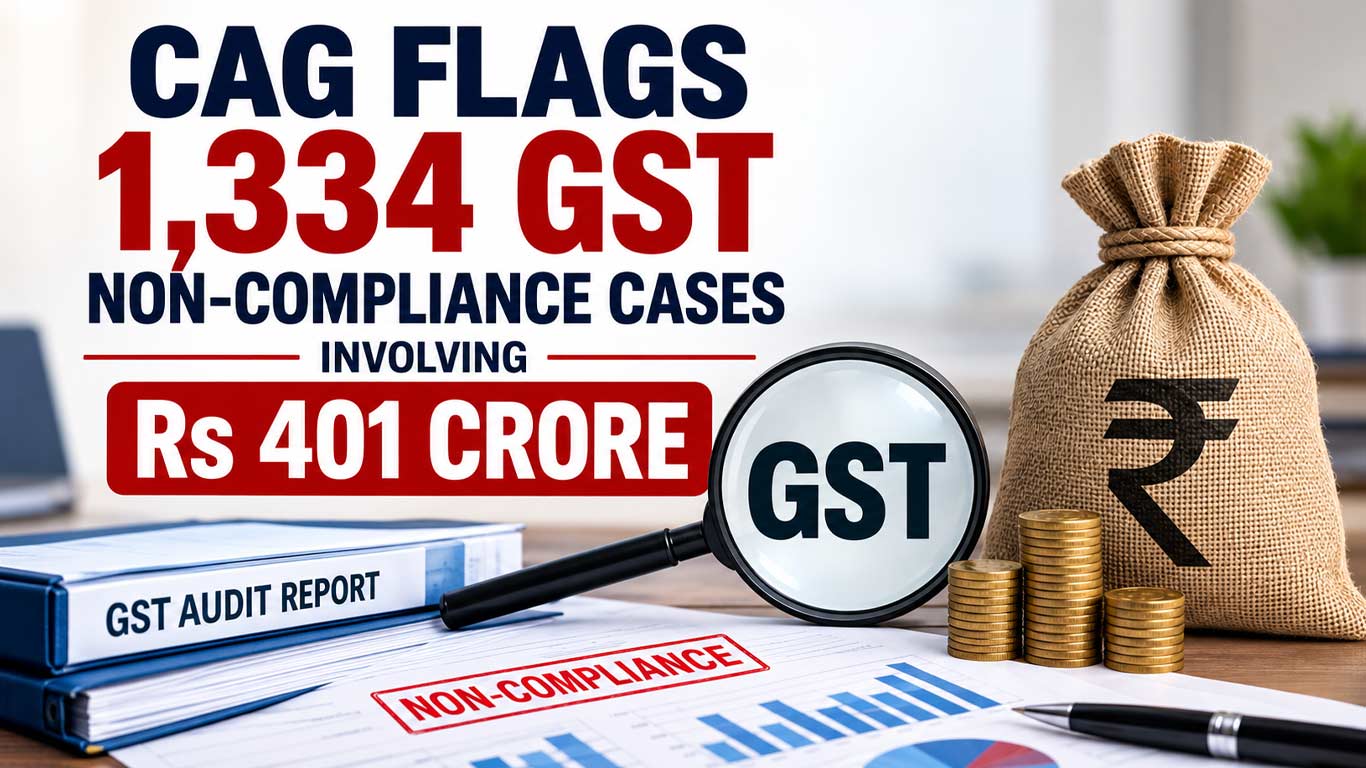
New Delhi, Aug 14 (KNN) The Comptroller and Auditor General (CAG) has detected 1,334 cases of Goods and Services Tax (GST) non-compliance in the works contract and construction sector involving Rs 401.42 crore, according to its latest report tabled in Parliament.
The Central Board of Indirect Taxes and Customs (CBIC) has accepted the audit observations in 903 cases involving Rs 268.36 crore and recovered Rs 15.88 crore so far.
The CAG's report on the Department of Revenue, covering the period ended March 2024, was based on an examination of GST returns and related records of 850 taxpayers and 71 GST department offices. The audit primarily covered FY2020-21 and FY2021-22, with some checks extending to FY2023-24, the Business Standard reported.
Concessions, ITC and Tax Payments Flagged
The audit identified several compliance issues, including incorrect claims of concessional GST rates or exemptions on road, bridge, railway and earthwork contracts, short payment of tax on work undertaken for government bodies and inadequate payment under the reverse-charge mechanism by builders and developers.
Other issues included irregular input tax credit (ITC) claims on ongoing and completed projects, incorrect declaration of service codes and additional places of business, and mismatches between ITC claims and tax paid, along with short payment of interest.
In 123 cases, these issues had a revenue impact of Rs 190.98 crore. Another 1,057 deficiencies involving 522 taxpayers accounted for Rs 188.98 crore.
Audit Finds Gaps in Records and Oversight
The CAG also faced difficulties in obtaining complete records. In 431 cases involving 392 taxpayers, detailed documents were not fully produced, with mismatches of Rs 2,732.56 crore identified in tax liabilities, ITC and concessional rates.
In another 22 cases, basic returns and statements were unavailable in the department's system, indicating potential mismatches involving Rs 36.09 crore.
The audit found deficiencies in 57 of the 71 GST offices examined. Scrutiny was either delayed or inadequately conducted in several cases, while follow-up action on risk alerts issued by the Directorate General of Audit and Risk Management was incomplete.
GSTN System Gaps Persist
The report also examined the third phase of the CAG's audit of GST Network (GSTN) information technology systems. Of 56 issues pending from earlier audits, GSTN had resolved 38, partially resolved one and was working on three. The remaining issues were unresolved or only partly addressed.
The CAG identified weaknesses in the GST registration and returns modules, including inadequate validation checks and delays in registration approval or cancellation. Gaps were also found in checks relating to return filing, interest calculation, ITC reversal and eligibility.
The audit further flagged issues in Integrated GST (IGST) settlement, including non-generation of some reports and errors in tax apportionment. Monitoring of taxpayers under the Composition Levy Scheme was also found to be inadequate.
While GSTN was largely compliant with IT governance and security requirements, the CAG pointed to gaps in planning for higher portal capacity and more resilient data centres.
CAG Recommends Stronger Compliance Checks
The CAG has recommended expanding scrutiny and internal audits of subcontractors claiming GST concessions on road, bridge, railway and earthwork contracts and introducing system-based validation to detect irregular claims.
It also recommended greater focus on reverse-charge cases involving purchases from unregistered suppliers and services received from government entities.
The report called for better coordination between the indirect tax and income tax authorities so that income identified by the Central Board of Direct Taxes (CBDT) is also examined for potential GST liabilities.
Indirect tax collections increased 8 per cent year-on-year, or Rs 1.14 lakh crore, in FY2023-24, led by a 13 per cent rise in Central GST revenue. However, the indirect taxes-to-GDP ratio declined to 4.98 per cent from 5.15 per cent, partly due to continued weakness in central excise collections.
The report noted that although GST revenues have continued to grow, compliance gaps among construction-sector taxpayers and weaknesses in tax administration systems continue to pose risks to revenue mobilisation.
(KNN Bureau)







 Loading...