INMAS-DRDO International Conference Focuses On Biomedical Solutions For Space Radiation Risks
Updated: Feb 28, 2025 02:24:52pm

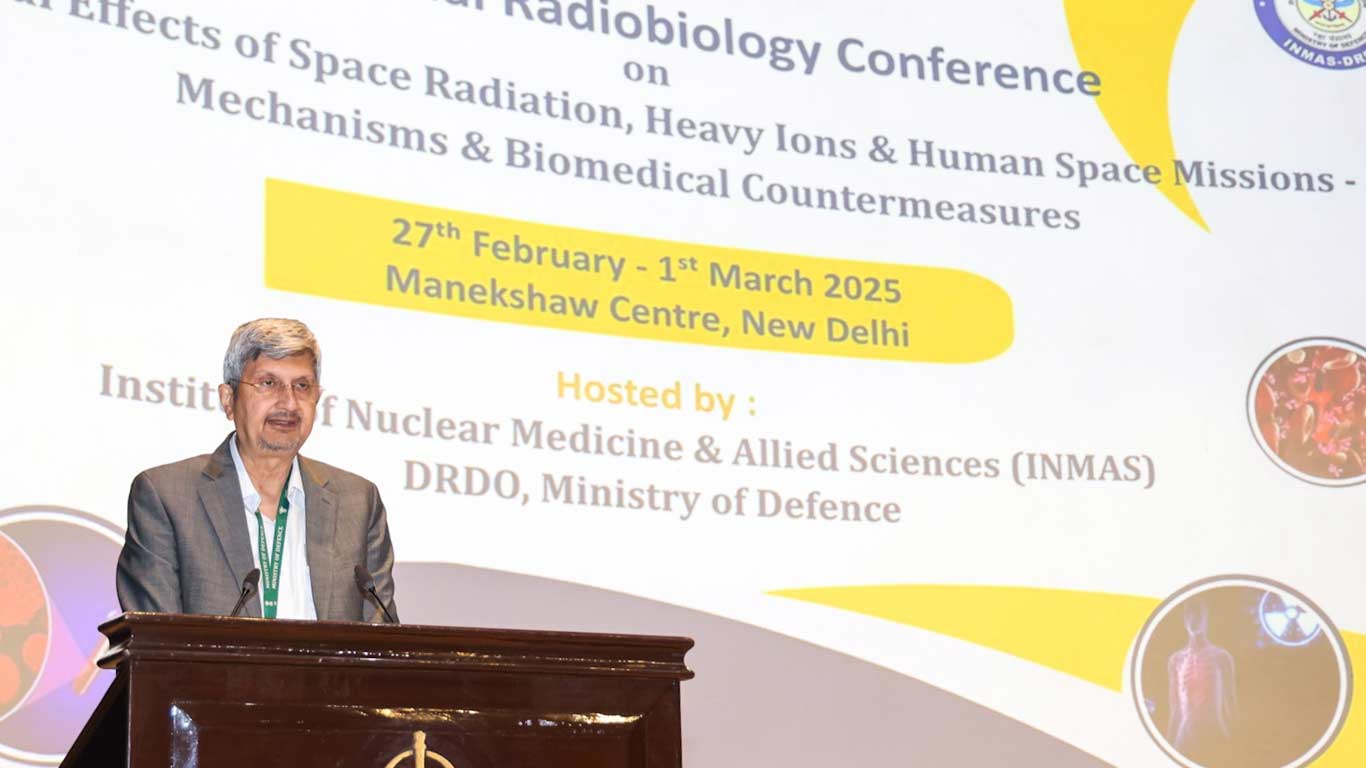
INMAS-DRDO International Conference Focuses On Biomedical Solutions For Space Radiation Risks
New Delhi, Feb 28 (KNN) The Institute of Nuclear Medicine & Allied Sciences (INMAS), a Delhi-based laboratory of the Defence Research and Development Organisation (DRDO), inaugurated the International Radio Biology Conference on Biological Effects of Space Radiation, Heavy Ions and Human Space Missions at the Manekshaw Centre, Delhi.
The three-day conference, which began on February 27, 2025, and will continue until March 1, 2025, focuses on mechanisms and biomedical countermeasures for space radiation exposure.
Prof. Ajay Kumar Sood, Principal Scientific Adviser to the Government of India, served as the Chief Guest at the inaugural ceremony.
In his address, Prof. Sood commended INMAS for organising this significant event and highlighted space radiation as one of the most formidable challenges in space exploration, posing substantial risks to astronauts' health during extended space missions.
He expressed appreciation for INMAS's ongoing efforts to address these complex challenges.
Dr. Samir V. Kamat, Secretary of the Department of Defence R&D and Chairman of DRDO, who attended as the Guest of Honour, emphasised the necessity of an integrated approach to tackle space radiation challenges.
He described the conference as a vital forum for knowledge exchange among radiobiologists, physicists, engineers, and medical researchers.
Dr. Kamat stressed that interdisciplinary collaboration is essential for developing innovative technologies and solutions to protect astronauts in the harsh space environment.
In his address, Dr. Kamat also noted that exploring outer space for humanity's benefit has become a critical priority in modern times.
He referenced significant achievements such as the sustained human presence on the International Space Station and lunar missions as evidence of our increasing capability to support life beyond Earth.
He expressed confidence that by developing effective protective strategies, India would be able to ensure astronaut safety and wellbeing, facilitating successful long-term missions to Mars and beyond.
The conference will address various aspects of space radiation biology through focused thematic areas including biomarkers of exposure and susceptibility, chronic effects and carcinogenesis, and the impacts of combined stressors such as microgravity, confinement, circadian misalignment, isolation, and space radiation.
Additional topics include acute and chronic effects of heavy ions, mathematical modeling and simulation, medical countermeasures, cellular and molecular mechanisms, muscle and bone loss, and radiation-induced degenerative diseases affecting cognition.
The program will also cover aspects of heavy ions radiation chemistry.
(KNN Bureau)







 Loading...


