Textile And Apparel Exports Grow 1.8% Despite Global Headwinds: Government
Updated: Jul 21, 2026 04:19:41pm

Textile And Apparel Exports Grow 1.8% Despite Global Headwinds: Government
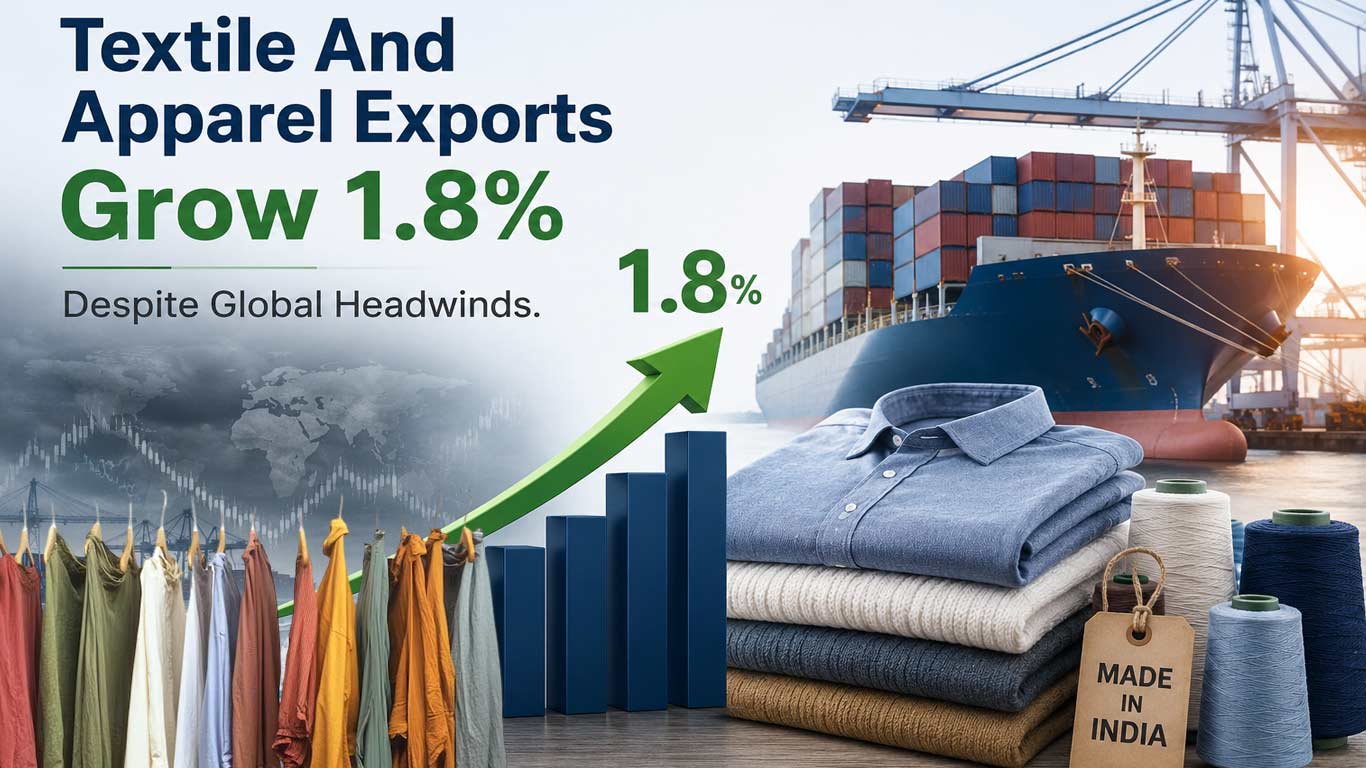
New Delhi, Jul 21 (KNN) India's textile and apparel exports, including handicrafts, increased 1.8 percent to Rs 3,25,339 crore in 2025-26, despite global economic headwinds and geopolitical disruptions, the government informed the Lok Sabha.
Exports stood at Rs 3,19,573.2 crore in 2024-25, according to data from the Directorate General of Commercial Intelligence and Statistics (DGCI&S).
Government Expands Support Measures
The government said it has implemented several initiatives to strengthen the competitiveness and export preparedness of the textile and apparel sector.
These include the PM Mega Integrated Textile Regions and Apparel (PM MITRA) Parks Scheme, the Production Linked Incentive (PLI) Scheme for Textiles, the National Technical Textiles Mission (NTTM), the SAMARTH skill development programme, and various export promotion measures, including market access support and interest subvention.
Relief Measures For Exporters
To support exporters amid evolving global challenges, the government has extended the Remission of Duties and Taxes on Exported Products (RoDTEP) scheme until September 30, 2026.
It has also temporarily exempted customs duty on imported cotton between June 1 and October 31, 2026, and removed customs duties on key inputs in the man-made fibre (MMF) value chain, including Purified Terephthalic Acid (PTA) and Mono-Ethylene Glycol (MEG).
In addition, GST rates have been rationalised to address the inverted duty structure in the MMF value chain, while the Resilience & Logistics Intervention for Export Facilitation (RELIEF) initiative has been launched to assist exporters affected by disruptions to maritime logistics in West Asia.
Trade Agreements To Boost Market Access
The government said the Rebate of State and Central Taxes and Levies (RoSCTL) scheme for garments and made-ups has also been extended until September 30, 2026, to provide policy stability for exporters.
It added that India has adopted a market diversification strategy covering 40 priority countries and currently has 16 Free Trade Agreements (FTAs) in force, including the recently signed India-UK Comprehensive Economic and Trade Agreement (CETA).
The government also noted that FTA negotiations with the European Union have been concluded, while an agreement has been signed with New Zealand, creating additional export opportunities for the textile and apparel sector.
According to the government, these measures have strengthened supply chain resilience, improved market access, including through e-commerce, and enhanced the competitiveness of Indian exporters, particularly micro, small and medium enterprises (MSMEs).
(KNN Bureau)








 Loading...