India’s Solar Manufacturing Capacity Surges, But Value Chain Integration Remains Key Challenge: IEEFA
Updated: Sep 01, 2026 02:56:11pm

India’s Solar Manufacturing Capacity Surges, But Value Chain Integration Remains Key Challenge: IEEFA
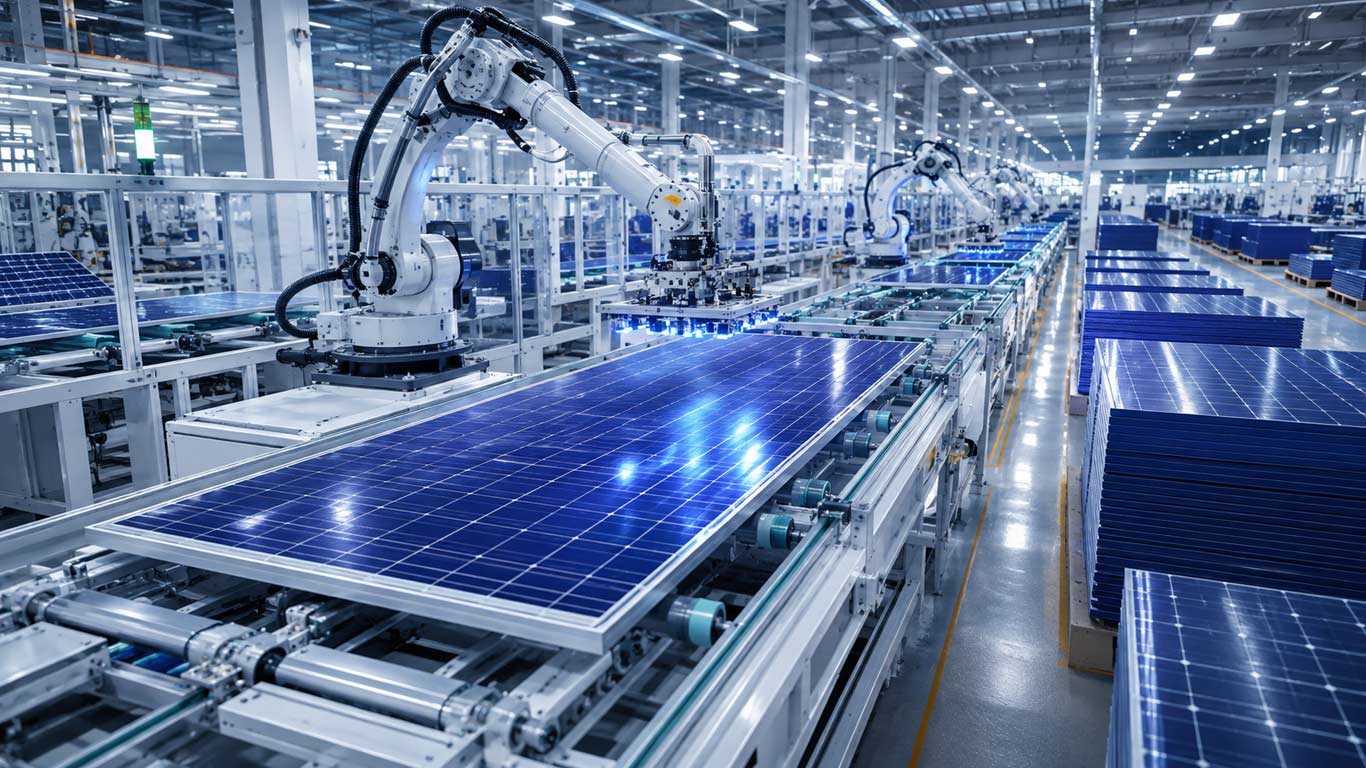
New Delhi, Sept 1 (KNN) India’s solar PV manufacturing capacity has surged, with domestic module capacity reaching around 233 GW by June 2026, but growing overcapacity risks persist as upstream segments such as cells, wafers and polysilicon remain underdeveloped, according to Institute for Energy Economics and Financial Analysis (IEEFA).
India has shifted from near-total reliance on imported solar PVs to becoming a major global manufacturing hub, though capacity growth remains concentrated in module assembly, creating imbalances across the value chain.
Solar Module Capacity Surges, Raising Overcapacity Risks
Around 135 GW of additional module capacity is backed by firm investment commitments, raising concerns over excess capacity. Current utilisation is estimated at just 35–40 percent, below the 50–65 percent considered sustainable by industry stakeholders.
JMK Research expects module capacity to remain ahead of demand through 2030, with polysilicon facing the largest supply gap while module and, to some extent, cell capacity may remain in surplus.
The imbalance stems from module assembly’s lower capital needs and faster commissioning, while cell and wafer production require greater investment and specialised expertise. ALMM mandates taking effect earlier for modules than for cells and wafers further reinforced the concentration.
Green Hydrogen, Data Centres Could Add Demand
The analysis said additional demand from data centres, green hydrogen and ammonia projects, as well as exports, could help absorb part of the excess capacity by 2030.
Green hydrogen is expected to provide significant incremental demand due to the renewable power required for production, although it may not fully absorb the planned expansion.
Export Diversification Key To Capacity Utilisation
Exports will be crucial to utilising India’s growing solar manufacturing capacity, but heavy reliance on the US market exposes manufacturers to trade-policy risks, highlighting the need for export diversification.
Europe offers a potential medium-term market, though greater access alone may not be enough. Indian manufacturers will need to improve cost competitiveness and narrow the technology gap with China through scale, vertical integration and operational efficiency.
Industry Consolidation Could Accelerate
The sector could also see greater consolidation, with smaller and non-integrated manufacturers facing pressure while larger vertically integrated companies gain an advantage.
Manufacturing is expected to expand progressively into cells, wafers and polysilicon, reducing dependence on imported inputs.
Pax Silica Could Support Supply Chain Diversification
India’s participation in the Pax Silica coalition could help diversify silicon-based solar manufacturing inputs and reduce dependence on China. The analysis said the sector’s focus must now shift from capacity creation to higher utilisation, competitiveness and deeper value-chain integration.
Policy priorities could include upstream manufacturing, industry-research collaboration, targeted export support and faster power transmission and right-of-way approvals to accelerate renewable deployment.
Domestic Cell Availability Remains A Near-Term Constraint
Limited availability of ALMM List II-compliant domestic cells is constraining module makers without captive production. The end-2026 exemption for net-metering and open-access projects provides time for domestic cell capacity to scale up and ease utilisation pressures.
The report said upstream integration, export diversification and technology development will be key to achieving sustained global competitiveness.
(KNN Bureau)










 Loading...


