India's Energy Storage Capacity Must Expand 7.6 Times By FY32: CareEdge
Updated: Oct 31, 2026 01:21:26pm

India's Energy Storage Capacity Must Expand 7.6 Times By FY32: CareEdge
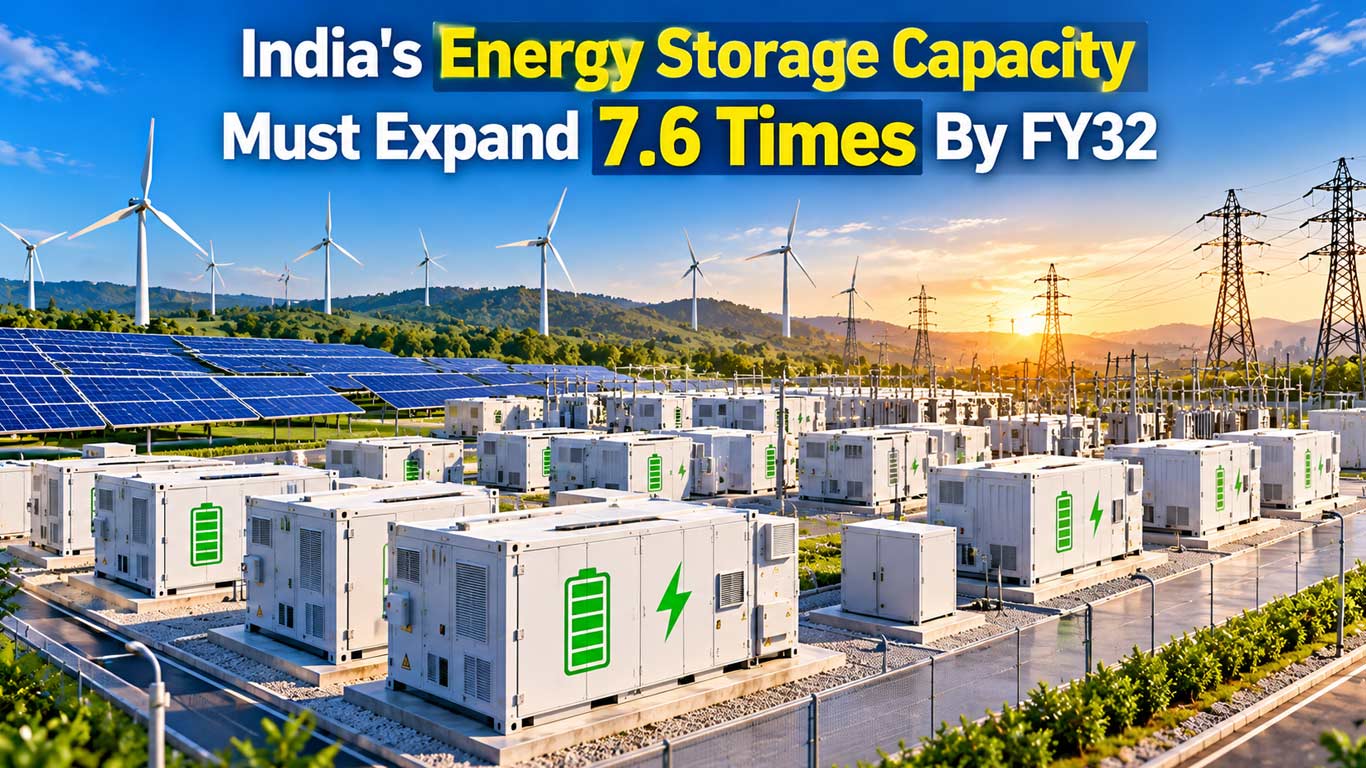
New Delhi, Oct 31 (KNN) India will need to add 357.4 gigawatt-hours (GWh) of energy storage capacity over the next six years to support its expanding renewable energy sector, according to a report by CareEdge.
The country's operational storage capacity stood at around 54 GWh as of June 2026, against a projected requirement of 411.4 GWh by FY32 under the Central Electricity Authority's (CEA) National Electricity Plan.
This means India's storage infrastructure will need to expand nearly 7.6 times from its June 2026 level to meet the projected requirement.
The gap assumes significance as renewable energy capacity continues to grow, increasing the need for infrastructure to store surplus electricity and supply it during periods of peak demand, the report noted.
Battery And Pumped Storage Requirements
Non-fossil sources accounted for 54.18 per cent of India's installed electricity generation capacity as of June 2026, surpassing fossil fuel-based capacity. However, coal continues to account for the majority of actual electricity generation, reported Money Control.
According to the National Electricity Plan, India's storage requirement by FY32 comprises 236.22 GWh from battery energy storage systems (BESS) and 175.18 GWh from pumped storage projects.
The government has estimated investments of around Rs 3.49 lakh crore in battery storage and Rs 1.29 lakh crore in pumped storage by FY32, taking the combined projected investment requirement to approximately Rs 4.78 lakh crore.
Grid Infrastructure Emerges As Key Challenge
CareEdge-ESG noted that India's renewable energy expansion is creating investment opportunities beyond generation capacity, particularly in energy storage, transmission infrastructure and grid modernisation.
The rapid addition of renewable energy projects has also increased pressure on the country's electricity transmission network, the report said.
Unlike conventional thermal power plants, solar and wind installations cannot generate electricity continuously. The challenge is therefore shifting from simply expanding renewable generation capacity to ensuring that electricity can be stored, transmitted and supplied reliably.
CareEdge-ESG identified transmission infrastructure as one of the major gaps in India's energy transition, noting that grid development has struggled to keep pace with renewable capacity additions.
Storage Crucial To 500 GW Target
With India targeting 500 GW of non-fossil electricity capacity by 2030, expanding energy storage infrastructure will be critical to integrating intermittent renewable power into the grid.
The development of storage, transmission and modern grid systems will help translate the country's renewable capacity expansion into reliable electricity supply and greater utilisation of clean energy.
(KNN Bureau)







 Loading...