Long-Duration Energy Storage Key to Meeting India's 500 GW Non-Fossil Capacity Target by 2030: Report
Updated: Oct 31, 2026 02:44:52pm

Long-Duration Energy Storage Key to Meeting India's 500 GW Non-Fossil Capacity Target by 2030: Report
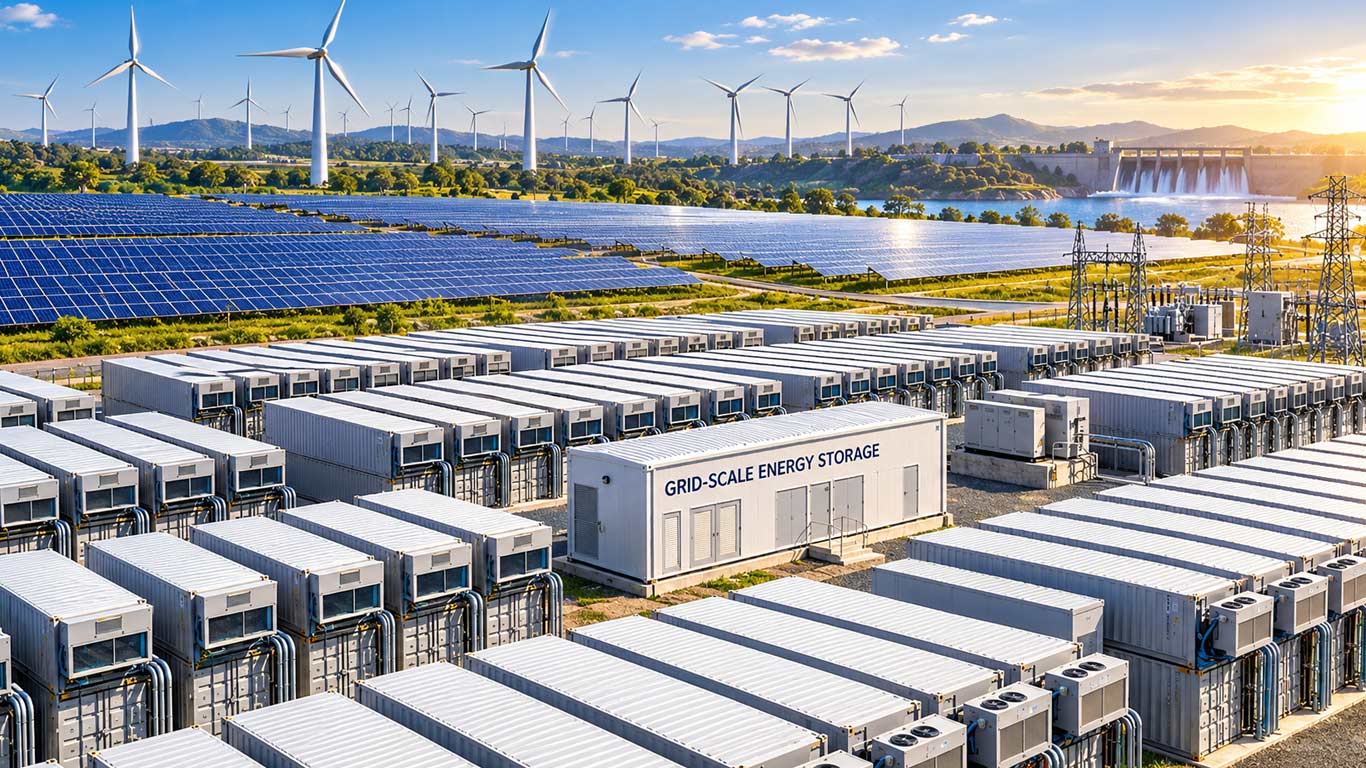
New Delhi, Oct 31 (KNN) India's target of achieving 500 GW of non-fossil fuel energy capacity by 2030 will depend on scaling up long-duration energy storage (LDES), with the proposed viability gap funding (VGF) framework in FY28 expected to play a key role in accelerating deployment, according to a report.
A report by the India Energy Storage Alliance (IESA), in association with Customized Energy Solutions (CES), titled ‘Long-Duration Energy Storage: Global Outlook and India's Deployment Pathway’, said the focus of the energy transition was shifting from adding renewable energy capacity to improving its integration and utilisation through storage solutions that support grid stability and energy resilience, PTI reported.
It highlighted that India curtailed 2.3 terawatt-hours (TWh) of solar energy over eight months in 2025 due to grid and storage constraints, underlining the need for greater grid flexibility.
Global LDES Requirements and Investment Needs
According to the LDES Council, the world will require around 8 terawatts (TW) of LDES capacity, equivalent to 140 TWh of storage, by 2040. Against this, only 117 GW was operational globally in 2025, requiring deployment to increase nearly 50-fold.
Meeting the requirement will need an estimated USD 4 trillion in capital investment and could generate around USD 540 billion in annual system-wide savings.
However, the current global project pipeline stands at just 0.22 TW, around 3 per cent of the 8 TW target, indicating substantial scope for accelerated investment.
IESA President Debmalya Sen said LDES would be critical to maximising renewable energy utilisation, improving grid stability and strengthening the resilience of India's power system. He said appropriate policy support, innovative business models and technology-neutral investment could help India establish a global benchmark in sustainable energy integration.
India Needs to Diversify Storage Technologies
The Central Electricity Authority (CEA) estimates that India will require 34.5 GWh of battery energy storage system (BESS) capacity by FY2027. Of this, 9.3 GWh has been commissioned, while another 195 GWh of projects have been awarded or are under tender.
The report noted that most of the project pipeline is concentrated on short-duration storage, highlighting the need to expand long-duration technologies capable of providing grid balancing and energy supply over extended periods.
It identified flow batteries for daily storage cycles of eight to 12 hours, iron-air batteries for multi-day flexibility, and pumped hydro, compressed air and thermal energy storage for large-scale and industrial applications. The appropriate technology mix would depend on grid requirements, project economics and deployment conditions.
Policy and Financing Support Needed
The report identified the absence of a formal statutory definition of long-duration storage and a dedicated funding mechanism for projects offering eight hours or more of storage as key policy gaps.
It said the anticipated FY28 VGF framework could help address financing challenges and accelerate LDES deployment as India moves towards its renewable energy and net-zero goals.
(KNN Bureau)





 Loading...